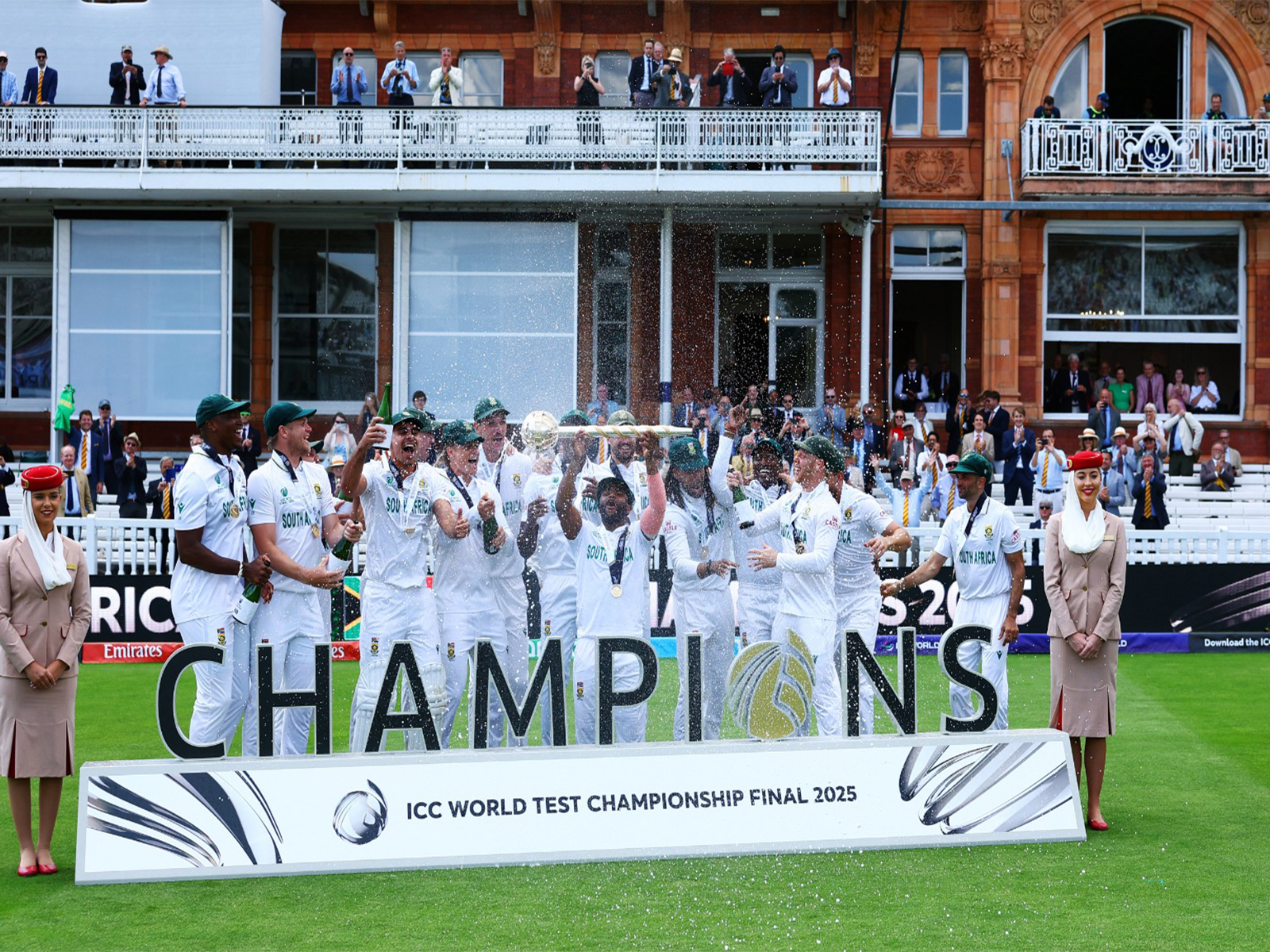
Durban [South Africa], October 7 (ANI): Cricket Australia (CA) chief executive Todd Greenberg hinted at the possibility of the current nine-team World Test Championship (WTC) expanding to 12 teams in the coming years.
The various member boards of the International Cricket Council (ICC), the world’s cricket governing body, are currently putting together the next Future Tours Programme (FTP), with the process in its final stages and talks of expanding the WTC running alongside it.
Since its inception in 2019, the WTC has featured a total of nine teams playing six series (three at home and away each) during a two-year time frame to determine the finalists. The series are a minimum of two Test matches, but the cycle from 2029-2031, coming under the future model, could allow Zimbabwe, Ireland and Afghanistan, which mostly play one-off Tests or two Test matches at best, to be part of the championship. The final decision is expected during the ICC meetings in Bali next month, as per Cricinfo.
On if a 12-team WTC could be signed off on, Greenberg said as per Cricinfo, “I think that’s what will happen for the next two years.”
However, Greenberg highlighted the issues related to sustainability and financial struggles for some boards, which will make it hard for boards to distribute more than they earn every year.
“But, ultimately, countries are going to have to make hard decisions themselves because if revenues do not continue to come in from the ICC at the levels that we have enjoyed, or they can’t generate their own FTP arrangements, then ultimately any business, ours is the same, you cannot continue to distribute more than you earn every year. That is where global cricket finds itself in some parts,” he added.
Greenberg also said that the Test nations could dwindle in numbers, saying that the expensive nature of the format and eagerness of players to play Tests could contribute to decline in the number of nations.
“It was not very popular when I said that [about Test cricket], but I still say it is a statement of fact that over time it is getting more and more difficult for countries to play Test cricket because it is so expensive. When I say it’s expensive, don’t take that comment as being [about] putting on Test matches. It is the ability to invest in your system to create a structure for red-ball cricketers. You cannot just magically find 11 players to play Test cricket,” he said.
“I think there is a world where there will be member nations who do not play Test cricket, or they might have to play more away Test cricket than they do at home in order to keep Test cricket in their country [alive] and keep playing that format. I think we have got to think about it differently. This whole reciprocal nature is potentially sending some countries broke,” added Greenberg speaking on bilateral Test cricket.
For ODI cricket, there were talks in the ICC Dubai workshop last week of organising more multi-nation tournaments to give the 50-over format a much-needed push and context. One of the ideas mooted was an Intercontinental competition, pitting best continental teams against each other.
Regarding ODIs and T20Is, with the latter gaining more prominence in the calendar in 2020s, he said that there could be a “sort of up and down system between T20 and ODI cricket”.
“There might be a cycle of four years where we play slightly less ODIs, more coming into a World Cup cycle and maybe less in the outer years. I do not think it stops in the outer years, though. It might be a sort of up-and-down system between T20 and ODI cricket,” he said.
Greenberg spoke on how he is told the importance of ODIs in the talent pathway and how everyone at ICC level tells him the importance of the ODI World Cup to the commercial outcomes of global cricket.
“Everyone in high performance tells me how important ODI cricket is to the formation of players in the talent pathway. And everyone at the ICC level tells me how fundamentally important the ODI World Cup is to the commercial outcomes of global cricket. Those things are really important. If you anchor those two principles, then you’ve just got to find ways to make those games meaningful,” he signed off. (ANI)
Related reading