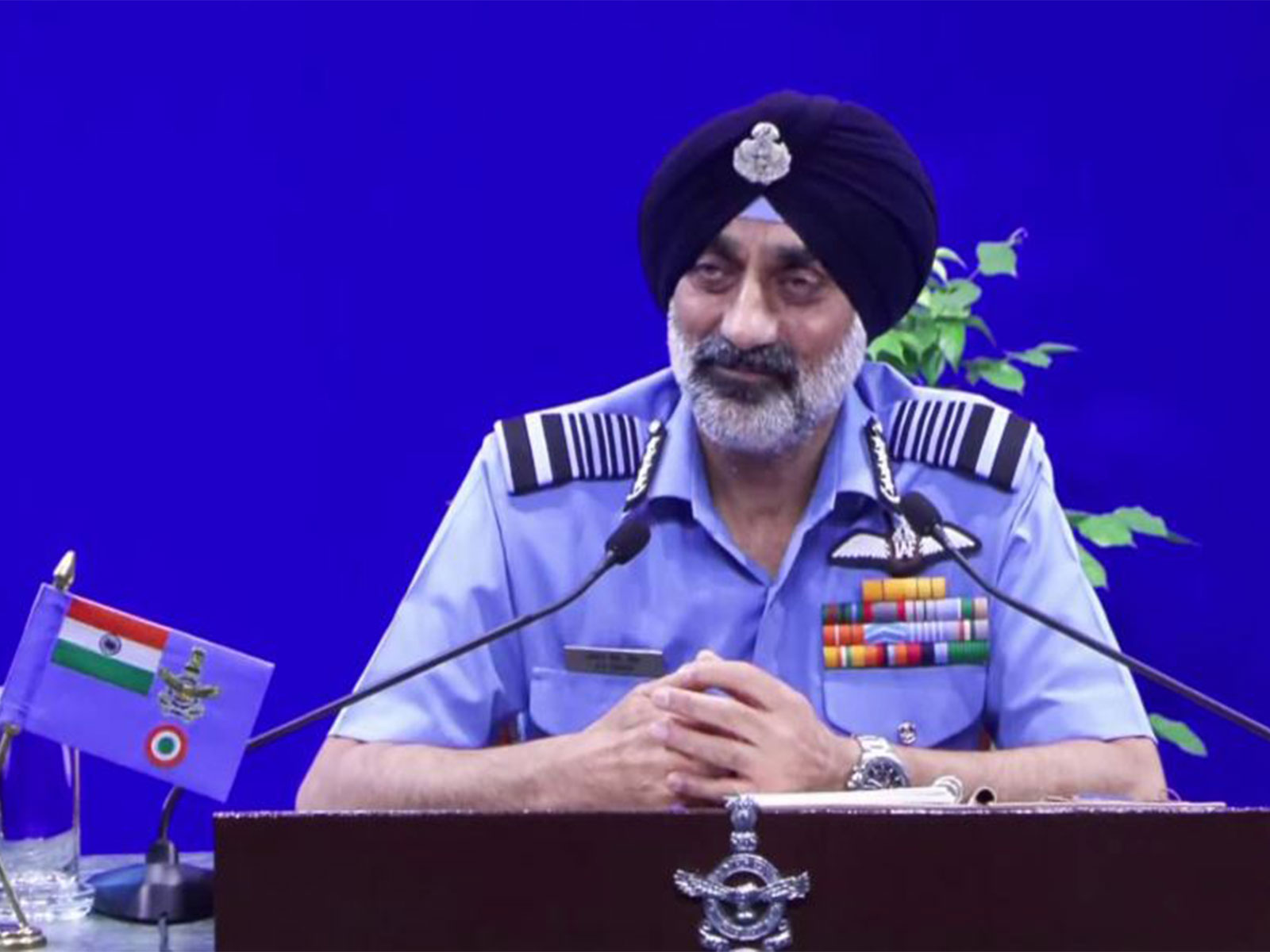
New Delhi [India], October 7 (ANI): Indian Air Force (IAF) Chief Air Chief Marshal AP Singh on Wednesday said the force’s transformation from a platform-centric approach to a capability-centric one, with greater emphasis on integration, was the result of processes that had begun several years ago, adding that the IAF was progressing in the right direction, although the pace could be improved.
Speaking at an event marking the eve of the IAF’s 94th anniversary at the Air Force Auditorium in Subroto Park, Singh outlined the progress made in the force’s modernisation and capability development programmes.
Singh said the IAF had moved towards integrating various components and that recent operational experience had demonstrated that it was progressing in the right direction.
He said air defence was keeping Indian skies safe, while long-range vectors were being employed against formations, command centres and other required targets. Several of these capabilities, he said, had been enabled by recent acquisitions and fast-track procurements aimed at improving integration.
The Air Chief said the role of air power as the mainstay of defensive action had been demonstrated effectively. While he expressed satisfaction with the direction of the IAF’s progress, he acknowledged that the pace could be faster.
“According to me, yes, we can be a little faster than what we are,” he said, while pointing to constraints related to procedures, procurement and development.
On the delayed LCA Mk1A programme, Singh said the IAF had a contract for 180 aircraft and had been actively engaging with Hindustan Aeronautics Limited (HAL) over the delays. He said extensive discussions had taken place on what could and could not be done and that a way forward had now been worked out.
He said the IAF was waiting for HAL to fulfil its commitments, with the last commitment having been made for September. Singh expressed confidence that the force would receive a ‘visible number’ of aircraft during the current financial year, as indicated by the Defence Secretary.
He said several other major procurement and development programmes were also progressing. These include the acquisition of 114 Multi-Role Fighter Aircraft (MRFA), Medium Transport Aircraft, Light Utility Helicopters, the design and development of the Indian Multi-Role Helicopter (IMRH), surface-attack systems and the combat aircraft programme.
According to Singh, some of these contracts could be signed during the current financial year, with more expected to follow in the next financial year.
On the C-295 programme, he said 16 aircraft had been delivered from abroad, while the remaining 40 aircraft were to be manufactured in India. The first aircraft being manufactured in India has already entered production testing, he said, adding that some minor issues were being resolved. He expressed hope that the aircraft would start coming up over the next one or two years.
On the AWACS programme, Singh said the contract for six AWACS Mk1A aircraft would be signed and was currently at the contract negotiation stage. The AWACS Mk2, based on the A321 platform, had already been signed, he said, adding that the modification cycle had commenced.
The Air Chief also outlined progress in the IAF’s unmanned systems programme. He said projects involving High-Altitude Long-Endurance (HALE) RPAs and Medium-Altitude Long-Endurance (MALE) RPAs were progressing, while the relevant procurement process was under negotiation.
At the same time, the IAF was pursuing the design and development of remotely piloted strike aircraft and UCAVs, he said.
Singh said a large number of design and development projects were being taken forward through various mechanisms, including smaller-scale industries and established design capabilities, with a significant focus on the private sector.
On air defence capabilities, he said a large number of surface-to-air guided weapon systems, ranging from long-range and short-range systems to close-in weapon systems, were in progress.
He said the IAF had 175 projects under the iDEX, Make and TDF schemes, which provide government support for smaller projects. These projects span several domains, including electronic warfare, counter-UAS systems, communication systems, weapon systems, defence cyber and artificial intelligence and machine learning.
On indigenisation, Singh said more than 76,000 parts had been indigenised through efforts involving the Defence Research and Development Organisation (DRDO), which, he said, would help improve the IAF’s sustainment capabilities.
He also highlighted significant enhancements in network-centric operations, interoperability of platforms and long-range weapon capability.
Singh said some of these capabilities were already in progress, while others had emerged from innovation groups and new ideas developed after observing developments in the operational environment.
On counter-UAS capabilities, he said that, apart from projects under the Make and iDEX schemes, the IAF had also undertaken procurements, including jammers. (ANI)
Related reading