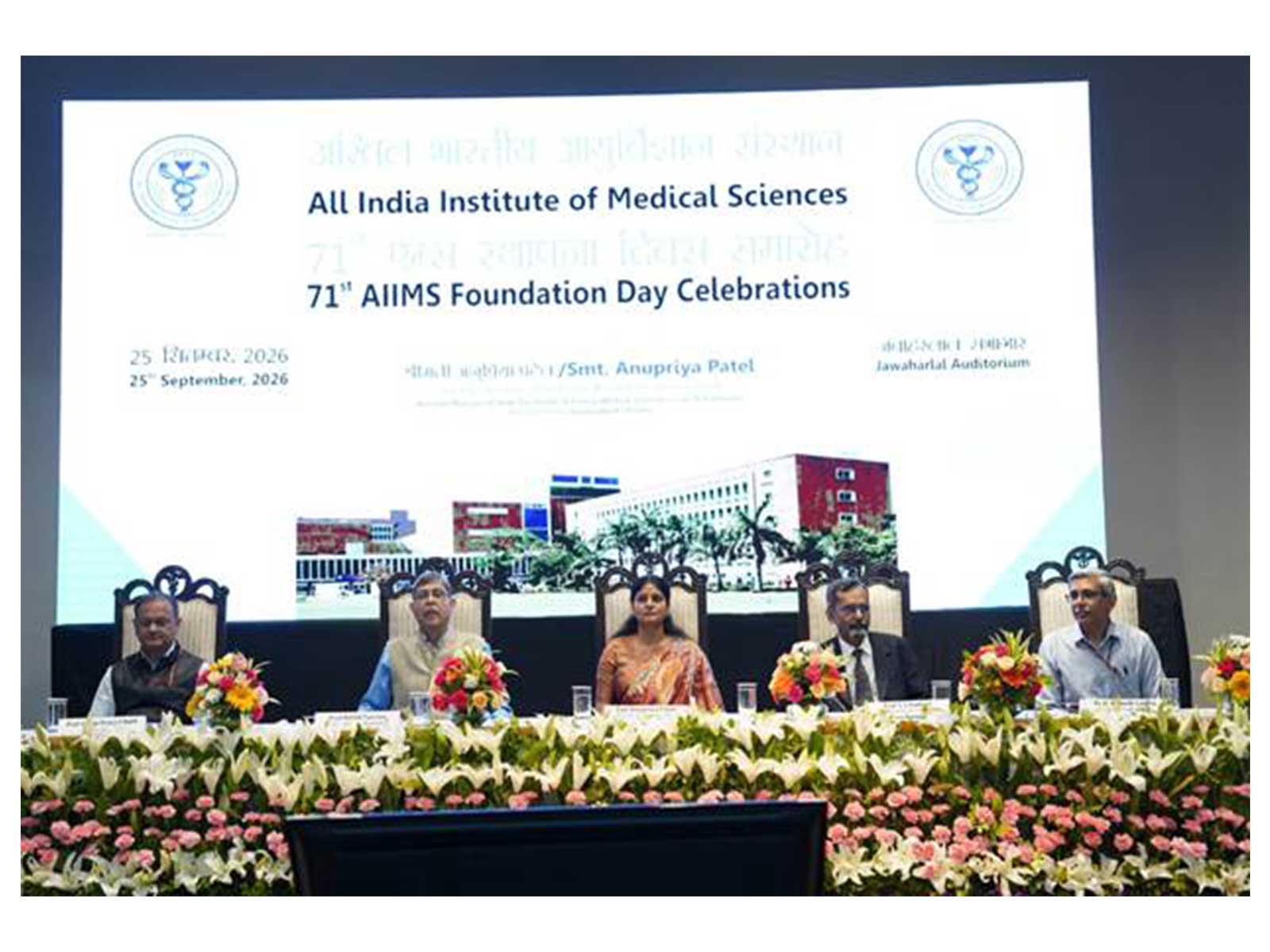
New Delhi [India], September 25 (ANI): Union Minister of State for Health & Family Welfare and Chemicals & Fertilisers, Anupriya Patel, on Friday addressed the 71st Foundation Day celebrations of the All India Institute of Medical Sciences (AIIMS), New Delhi, as the Chief Guest. The celebrations marked over seven decades of AIIMS’ contributions to healthcare, medical education, research and innovation.
Addressing the gathering, Anupriya Patel said that “since its inception in 1956, AIIMS New Delhi has occupied a special place in the healthcare journey of the country.”
She highlighted its contribution to redefining medical education, pioneering groundbreaking research and delivering high-quality patient care. She underlined that “over the decades, the name AIIMS has become synonymous with clinical excellence and public trust.”
She noted that while the institution has a distinguished legacy, this legacy also brings greater responsibility for the future and requires continued focus on national healthcare priorities.
Patel highlighted the transformation of India’s healthcare and medical education landscape. She noted that the country has expanded from one AIIMS at the turn of the century to a network of 23 AIIMS institutions. Since 2014, the number of medical colleges has increased from 387 to over 800, while undergraduate medical seats have increased from 51,000 to nearly 1.3 lakh, along with a substantial expansion in postgraduate opportunities.”
She further added that the Government envisions adding another 75,000 medical seats to further strengthen this framework. This expansion is not merely a matter of numbers but is closely linked to equity and access.”
Patel further emphasised that “quality medical education must reach every region, advanced tertiary healthcare must be brought closer to citizens, and the country must build a strong pool of doctors, nurses, scientists and allied healthcare professionals capable of responding to changing demographic and epidemiological needs.”
She added that “AIIMS New Delhi has a special responsibility in this transformation as the apex mentor and as an institution that has established a benchmark for the rest of the country.”
Speaking about the scale of healthcare services at AIIMS New Delhi, Patel said that the institution’s enormous clinical volume should not be viewed merely through statistics. Millions of outpatient visits represent individuals and families placing their trust in the institution, while admissions and surgeries represent situations in which patients entrust their lives to its doctors, nurses and support staff.
She emphasised that AIIMS is therefore not only a centre of medical excellence but also an institution of public trust, and that this trust has to be earned and nurtured every day.
Patel also highlighted AIIMS’ role at the forefront of advanced medical care and emerging technologies, including Artificial Intelligence (AI), robotic surgery, organ transplantation and advanced diagnostics. She emphasised that “technology must remain an instrument for better patient care and should complement, rather than replace, human clinical judgement.”
She noted that “AI cannot replace a physician’s intuition, a robotic arm cannot replace a surgeon’s judgement, and technology cannot replace the reassuring human presence of a nurse.” She stressed the importance of maintaining a balance between scientific advancement and the human touch in healthcare.
She also underlined that quality healthcare must also be reflected in the patient’s overall experience. She called for the AIIMS premises to be made more navigable for citizens and emphasised the importance of empathy, clear communication, dignity and patient-centred care. She also referred to the importance of patient safety and the collective responsibility of doctors, nurses, technicians and administrative personnel in ensuring safe and quality healthcare.
Patel emphasised that expansion of healthcare infrastructure must go hand in hand with quality. She noted that a new ward requires adequate nursing support, specialised services require trained professionals, and digital initiatives should help reduce friction for patients. She stressed that growth and quality must progress together and that AIIMS New Delhi should continue to demonstrate that expansion in scale can coexist with high standards of patient care.
Highlighting the growing importance of preventive healthcare, Patel said that India’s health priorities increasingly focus on prevention, early detection and timely management, particularly in the context of non-communicable and lifestyle-related diseases.
Referring to the shift in the policy approach towards prevention and health promotion, she called upon AIIMS to leverage its intellectual capital to contribute to public health policy, community health, lifestyle management and preventive medicine.
Patel also underlined the importance of the National Health Policy, 2017, and the broader shift towards preventive and promotive healthcare. She said that healthcare must address the country’s changing epidemiological burden while ensuring that citizens have access to affordable and quality services.
Highlighting the role of Ayushman Bharat and Pradhan Mantri Jan Arogya Yojana (AB PM-JAY) in expanding access to healthcare and protecting vulnerable families from the financial burden of medical treatment, she noted that AB PM-JAY has completed eight years and has covered more than 62 crore beneficiaries, strengthening financial protection for people from poor and vulnerable backgrounds.
Patel further emphasised that AIIMS New Delhi must increasingly function as a national hub for capacity building and indigenous innovation. She emphasised that the impact of AIIMS should be measured not only by the number of patients treated on its campus but also by the national capacity it creates by training healthcare professionals and enabling AIIMS-level expertise to reach other parts of the country.
She also stressed that research should bridge the gap between the laboratory and the patient and translate into clinical use and public benefit.
Patel also underlined the need for greater development, validation and implementation of indigenous medical technologies. She said that India cannot rely indefinitely on imported medical technologies and that academia, hospitals and Indian industry must work together to develop solutions suited to the country’s healthcare requirements. She called upon AIIMS “to contribute to an ecosystem in which India not only adopts advanced healthcare solutions but also develops them.”
Patel called for greater attention to the health and well-being of healthcare professionals themselves. She emphasised that along with treating patients, the health of doctors and other healthcare professionals is equally important for building a healthy nation. She stressed the importance of inculcating healthy habits among healthcare professionals from a young age and promoting a culture that supports their well-being.
Patel urged AIIMS New Delhi to continuously examine areas where improvements can be made. Looking ahead, Patel called upon AIIMS New Delhi “to play an even more commanding role in advanced clinical care, nurture the next generation of compassionate healthcare professionals, undertake research addressing India’s unique health challenges and guide the broader AIIMS network as a unified family of institutions.” She emphasised that the quality of care and expertise developed at AIIMS New Delhi should have a wider national impact.
Patel expressed appreciation for the entire AIIMS family, including doctors, nurses, researchers, students, technicians, pharmacists, administrators, sanitation workers and security personnel, and acknowledged their collective contribution to the institution’s achievements. She called for patient care to become more accessible, safer and increasingly patient-centred, while emphasising that technology should strengthen and not replace the human relationship at the core of healing.
In her concluding remarks, Patel stated that AIIMS New Delhi has a distinguished past and a strong present, but carries an even greater responsibility to shape the future of Indian healthcare. She called for the institution to continue serving as a beacon of excellence, trust, affordability, innovation and selfless service to the people of India.
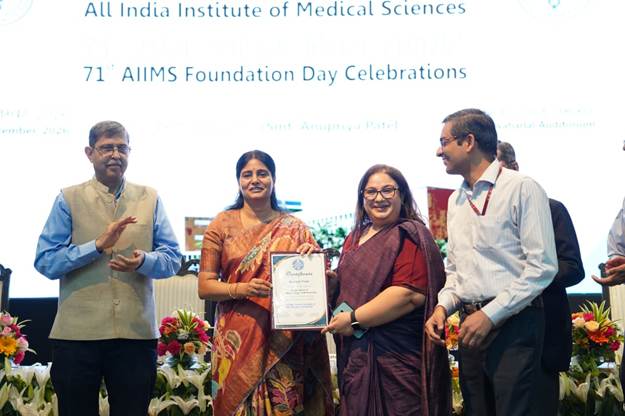
Patel also distributed awards to outstanding performers in different fields during the event.
As part of the celebrations, Anupriya Patel also inaugurated the exhibition “AIIMS: Seven Decades of Healthcare Innovation”. The exhibition showcases the journey of AIIMS and its contributions to healthcare and medical innovation through 95 posters, highlighting important milestones, achievements, initiatives and developments across the institution.
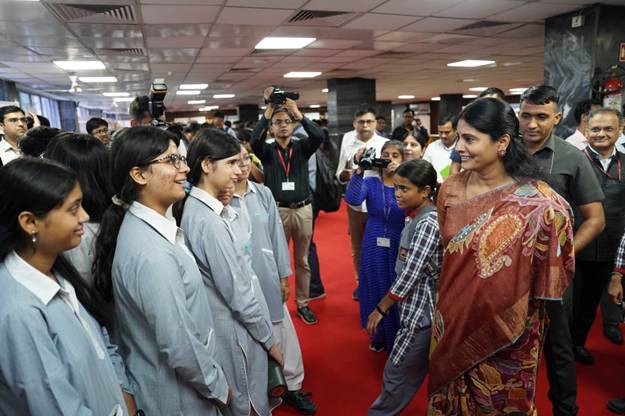
The exhibition also focuses on health education and community outreach. More than 1,500 school students will visit the exhibition and engage with interactive displays and live demonstrations on BMI assessment, healthy lifestyle and nutrition, blood sugar testing, common eye problems, dental and oral hygiene, organ donation and Cardiopulmonary Resuscitation (CPR) to learn how to revive critically ill patients. The exhibition will remain open from 25th to 27th September 2026.
Addressing the gathering, Director, AIIMS New Delhi, Nikhil Tandon highlighted the institution’s extraordinary scale of patient care, noting that AIIMS New Delhi recorded more than 50 lakh outpatient visits, admitted over 3.5 lakh patients and conducted nearly 3 lakh surgeries during the past year.
He emphasised that these figures reflected the immense trust placed by people across the country in the institution. He also highlighted major advances in clinical care, including the milestone of more than 1,000 robotic surgeries and the successful performance of India’s first reported robot-assisted kidney transplant in a public sector institution. AIIMS also doubled its dialysis capacity and undertook over 300 highly complex supermicrosurgical procedures.
Tandon further highlighted AIIMS New Delhi’s growing national role in capacity building, digital health, research and indigenous innovation. He noted that the institution welcomed around 1,000 new students and recruited over 300 faculty members during the year. He emphasised that AIIMS must extend its expertise beyond its campus through digital health, telemedicine and capacity-building initiatives to strengthen healthcare delivery across the country.
Dr. Shyam Sunder Kothari, Former Professor and Head, Department of Cardiology, AIIMS, New Delhi, faculty members, students and staff of AIIMS New Delhi were present on the occasion. (ANI)
Related reading