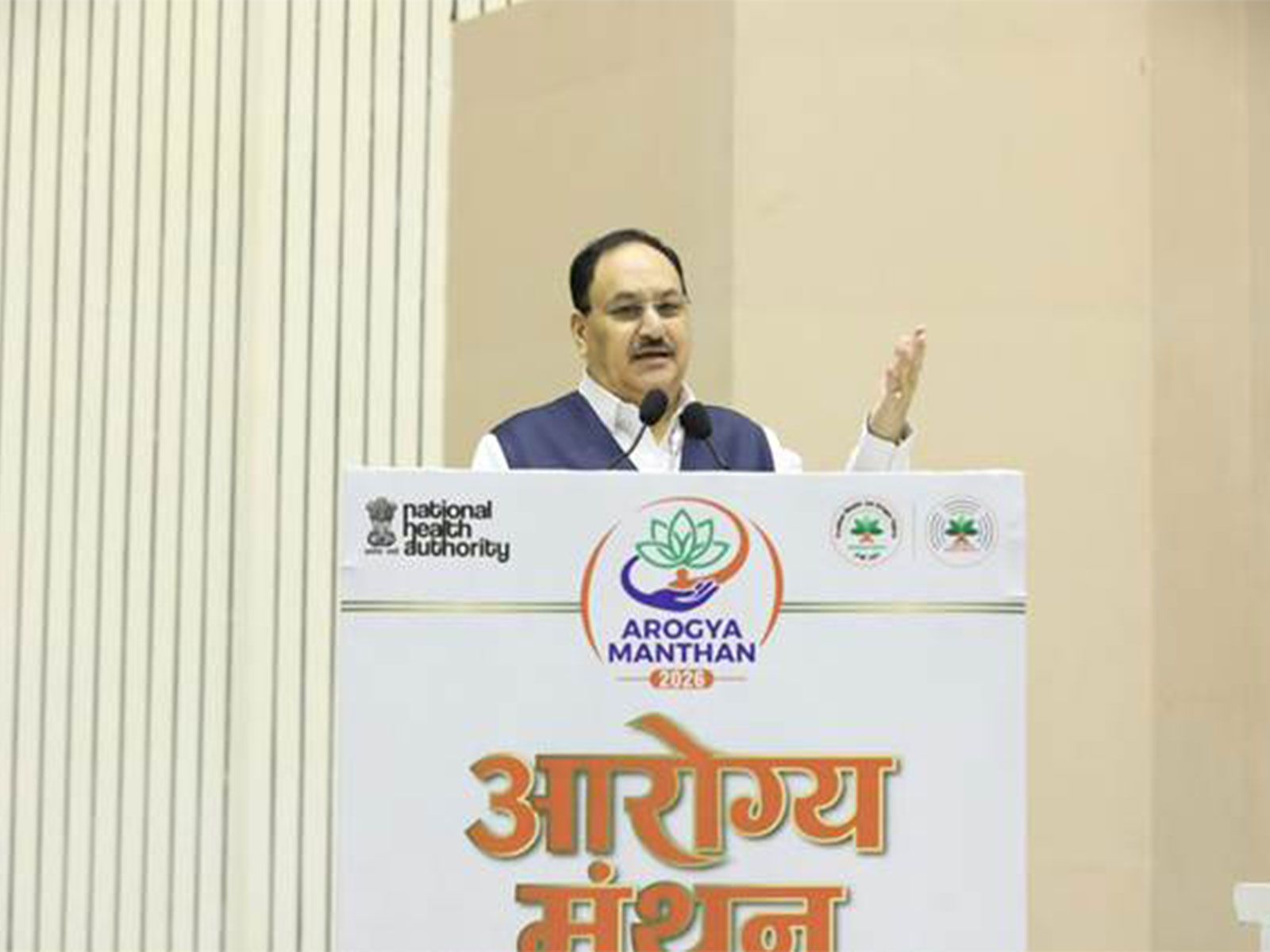
New Delhi [India], September 25 (ANI): Union Minister for Health and Family Welfare and Chemicals and Fertilisers, JP Nadda, on Friday inaugurated Aarogya Manthan 2026 at Vigyan Bhawan, New Delhi, marking eight years of Ayushman Bharat Pradhan Mantri Jan Arogya Yojana (AB PM-JAY) and five years of the Ayushman Bharat Digital Mission (ABDM).
According to the Health Ministry, organised by the National Health Authority (NHA), the event brought together senior government officials, healthcare providers, insurers, technology and digital health experts, academia, development partners and other stakeholders to deliberate on the progress of India’s health assurance and digital health ecosystem and the priorities for its next phase.
Addressing the gathering, Nadda congratulated all stakeholders on the completion of eight years of AB PM-JAY and five years of ABDM. He said that these milestones provide an opportunity to take stock of the progress made and renew the commitment towards the welfare of the poor and marginalised sections of society, in line with the Prime Minister Narendra Modi’s vision of “Sabka Saath, Sabka Vikas, Sabka Vishwas, Sabka Prayas.”
Nadda highlighted the significant expansion of AB PM-JAY since its inception and said that the scheme has emerged as the world’s largest health assurance programme, with more than 60 crore beneficiaries covered and over 13 crore hospital admissions facilitated, involving treatment worth more than Rs 2 lakh crore.
He noted that the Government further expanded the scheme to cover all senior citizens aged 70 years and above, irrespective of their socio-economic status, bringing them within its ambit. He also highlighted the importance of portability under the scheme, particularly for migrant workers, and appreciated the contribution of State Governments, healthcare institutions and other stakeholders in taking the programme forward.
The Union Minister said that the journey of AB PM-JAY and ABDM has demonstrated the transformative role of technology in healthcare, with digital systems supporting authentication, authorisation and access to treatment across locations. Highlighting the progress under ABDM, he said that more than 97.8 crore ABHAs have been created, with over 121 crore health records linked, while more than 5.6 lakh health facilities and around 11 lakh healthcare professionals are registered on the ABDM ecosystem. He also highlighted the development of the National Health Claims Exchange, which seeks to bring hospitals and insurers onto a common digital platform.
Referring to the initiatives launched at Aarogya Manthan 2026, Nadda said that these would further strengthen digital healthcare, facilitate the secure use of health data and create new opportunities for health research, innovation and data-driven decision-making. He appreciated the National Health Authority and acknowledged the role of State Governments, healthcare professionals, empanelled hospitals, Ayushman Mitras, ASHA and Anganwadi workers, technology partners and other stakeholders.
According to the ministry, Nadda emphasised that the journey must continue and called for sustained efforts to leverage digital technology to make healthcare more accessible, efficient and patient-centric. He expressed confidence that the deliberations at Aarogya Manthan 2026 would generate actionable outcomes and contribute further towards strengthening India’s health ecosystem and serving humanity.
Dr M Srinivas, Member (Health), Niti Ayoga, congratulated the National Health Authority (NHA) on the occasion. Highlighting the transformation brought about by AB PM-JAY, he said that the scheme has enabled people, particularly from economically weaker sections, to access healthcare with greater confidence and reduced financial burden. He emphasised that the next phase should focus on strengthening continuity of care, quality and patient-centric healthcare, including seamless referral mechanisms for patients requiring specialised treatment.
Dr Srinivas highlighted the importance of achieving wider adoption and saturation of ABHA and strengthening interoperability of digital health records, with citizen consent and appropriate safeguards. He stressed that high-quality, standardised and interoperable health data would be critical for advancing health research and responsibly leveraging Artificial Intelligence in healthcare. He also called for strengthening the National Health Claims Exchange, improving ease of claims and pre-authorisation processes, and expanding awareness of health assurance and digital health initiatives.
Ajay Seth, Chairman, IRDAI, highlighted the success of Ayushman Bharat PM-JAY and said that the experience gained through the scheme provides an opportunity to further strengthen the health insurance ecosystem in the country. He emphasised the need to ensure quality, affordability and access in healthcare while creating value for all stakeholders, including citizens, hospitals, insurers and technology providers.
Highlighting the importance of standardisation and transparency in health insurance, Seth underlined the need for wider adoption of key digital and operational building blocks, including ABHA as an identity for health insurance, codification of treatments, standard billing formats, and standard treatment protocols and guidelines. He also highlighted the role of India’s digital public infrastructure and the National Health Claims Exchange (NHCX) in enabling greater interoperability and creating a more connected health insurance ecosystem. He said, “It is within our reach to provide effective healthcare for the widest possible population — affordable and with good quality.”
Speaking at the occasion, Dr Rajiv Bahl, DG ICMR & Secretary DHR, highlighted the significance of the eight-year milestone of Ayushman Bharat PM-JAY and five years of ABDM, noting that Ayushman Bharat PM-JAY has emerged as the world’s largest health assurance scheme, covering and benefiting more than 60 crore citizens. He said the focus going forward would be on further improving the quality of healthcare and expanding coverage to ensure greater benefits for citizens.
Highlighting the collaboration between DHR, ICMR and NHA, Dr Bahl outlined two key areas of work. On standardisation of treatment, he noted that treatment based on standardised algorithms can help ensure greater consistency and quality of care, with ICMR having developed more than 150 standard treatment workflows and guidelines. He also highlighted the importance of cost-effectiveness in healthcare, noting that the Health Technology Assessment in India (HTAIn) under DHR evaluates the cost-effectiveness of healthcare technologies and interventions.
Sunil Kumar Barnwal, CEO, NHA, congratulated all stakeholders on achieving two significant milestones — eight years of Ayushman Bharat PM-JAY and five years of Ayushman Bharat Digital Mission (ABDM). He highlighted the scale and reach of both programmes, with over 49 crore Ayushman Cards and around 98 crore ABHA IDs generated across the country.
Looking ahead, he noted that Ayushman Bharat PM-JAY has generated more than 13 crore patient records, creating a valuable repository for research, development and health analytics. He said the Secure Data Environment will enable responsible use of such data while safeguarding patient identities. He also highlighted the launch of the Auto-Adjudication Framework, aimed at streamlining and strengthening the claims adjudication process under AB PM-JAY through technology and data-driven processes.
A major highlight of Arogya Manthan 2026 was the launch of a series of initiatives aimed at strengthening the digital foundations of India’s health assurance ecosystem. These included the National Healthcare Providers Registry (NHPR) Mobile App, NHCX Implementation Guide for Payers, Guidebook for a Model Digital Health Facility, Secure Data Environment (SDE) application and Framework for Auto-Adjudication of Claims under AB PM-JAY.
The Secure Data Environment, developed by the National Health Authority (NHA) with the support of the Indian Institute of Science (IISc), Bengaluru, is envisaged as a governed environment for access to and analysis of AB PM-JAY and ABDM health data. Approved entities will be able to work with de-identified data or execute code within an isolated NHA environment, with outputs reviewed before release. The initiative is intended to facilitate health research, programme planning, outcome analysis and responsible AI innovation, while incorporating safeguards for protection of personal data.
The deliberations at Arogya Manthan 2026 focused on strengthening the efficiency, quality and interoperability of health services. The session on “NHCX for Streamlining Health Insurance” examined the role of the National Health Claims Exchange (NHCX) in enabling streamlined, standardised and technology-driven health insurance processes, including how interoperable digital claims infrastructure can improve efficiency, strengthen coordination across the health insurance ecosystem, and open new avenues of health financing.
This was followed by parallel sessions under the AB PM-JAY and ABDM tracks, examining key aspects of programme implementation, healthcare delivery and digital transformation.
Under the AB PM-JAY track, the session on “Claim Processing to Intelligent Assurance: Transforming AB PM-JAY” examined the use of technology, data and analytics for strengthening claims processing and programme integrity. The session on “Strategic Purchasing from the Perspective of Quality and Cost-Effectiveness” discussed approaches to improving quality of care while promoting efficient utilisation of resources.
The ABDM track included discussions on “UHI for Improving Access of Healthcare Services”, focusing on the role of digital platforms in expanding access and participation across the healthcare ecosystem, and “Leveraging Standards for Better Health Delivery”, which examined the importance of common health-data standards for seamless exchange of information and improved continuity and quality of healthcare delivery.
The event also recognised States and Union Territories for their performance under AB PM-JAY and ABDM across different categories. Under AB PM-JAY, Andhra Pradesh, Sikkim and Jammu & Kashmir were recognised for the highest card saturation among ASHA, Anganwadi Worker (AWW) and Anganwadi Helper (AWH) beneficiaries in the large State, small State and Union Territory categories, respectively. Chhattisgarh, Maharashtra and Gujarat were recognised as the top-performing States in claim settlement for inter-State portability.
Under ABDM, Bihar, Ladakh and Dadra and Nagar Haveli were recognised as top-performing States/UTs across model districts based on district population categories. Chandigarh, Assam and Uttar Pradesh were recognised for the highest number of sub-centres using ABDM-enabled Health Management Information Systems (HMIS) in the small State/UT, medium State/UT and large State categories, respectively, the ministry stated. (ANI)
Related reading