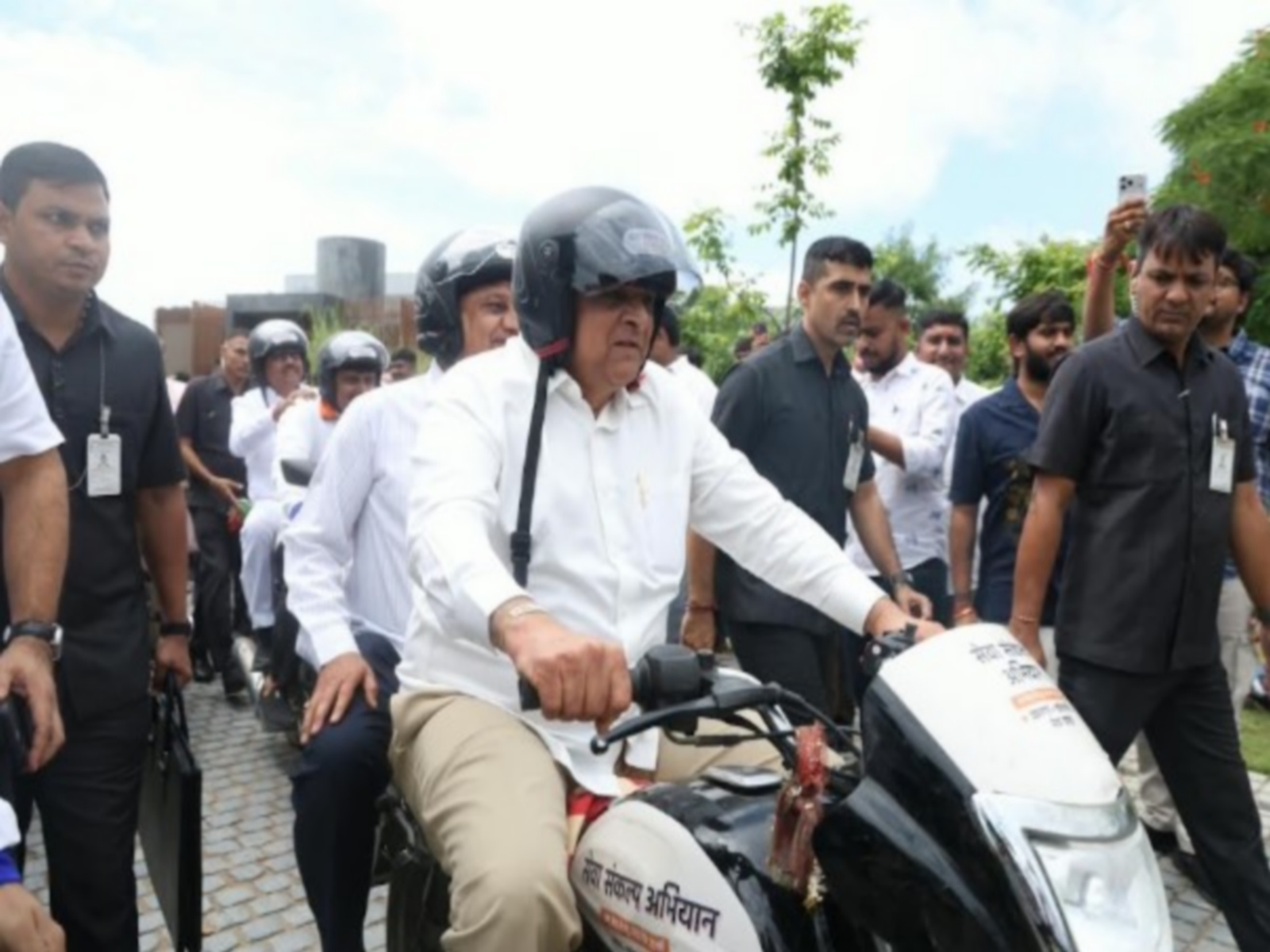
Gandhinagar (Gujarat) [India], September 18 (ANI): Gujarat Chief Minister Bhupendra Patel welcomed the historic bike yatra from Vadnagar to Varanasi, being organised as part of the nationwide ‘Seva Sankalp Abhiyan’, when it reached Sanand in Ahmedabad district.
According to the Gujarat Chief Minister Office (CMO), CM Patel himself rode a motorcycle and symbolically joined the yatra.
The nationwide ‘Seva Sankalp Abhiyan’ commenced on September 17 to mark the milestone of Prime Minister Narendra Modi completing 25 years of uninterrupted public service as Chief Minister of Gujarat and Prime Minister of India.
As part of the campaign, two historic bike seva yatras have been launched: one from Vadnagar to Varanasi and the other from Varanasi to Vadnagar.
The yatra from Vadnagar to Varanasi will pass through 10 states, 193 districts and around 1,159 villages, covering approximately 40,000 kilometres.
The journey will traverse 10 different routes and will highlight PM Modi’s 25-year journey of public service as well as various government welfare and development schemes.
Union Home and Cooperation Minister Amit Shah flagged off the bike seva yatra from Vadnagar on the occasion of Prime Minister’s birthday.
The yatra will conclude on October 7, marking the completion of 25 years of PM Narendra Modi’s journey in public life.
The bike seva yatras, originating simultaneously from Vadnagar and Varanasi, comprise 10 groups, with each group consisting of 25 motorcycles and 50 seva yatris. The Vadnagar-to-Varanasi yatra has 250 motorcycles carrying 500 seva yatris, while another 250 motorcycles with 500 seva yatris are participating in the Varanasi-to-Vadnagar yatra. Thus, around 1,000 young people from across the country are participating in the two yatras.
During the journey, various public-service and awareness programmes will be organised, including tree plantation drives, cleanliness campaigns, the Nasha Mukt Bharat Abhiyan, TB Mukt Bharat Abhiyan and water conservation awareness activities.
The participants will also honour sanitation workers and interact with beneficiaries of various government schemes, as well as young people and beneficiaries associated with women’s empowerment initiatives. (ANI)
Related reading