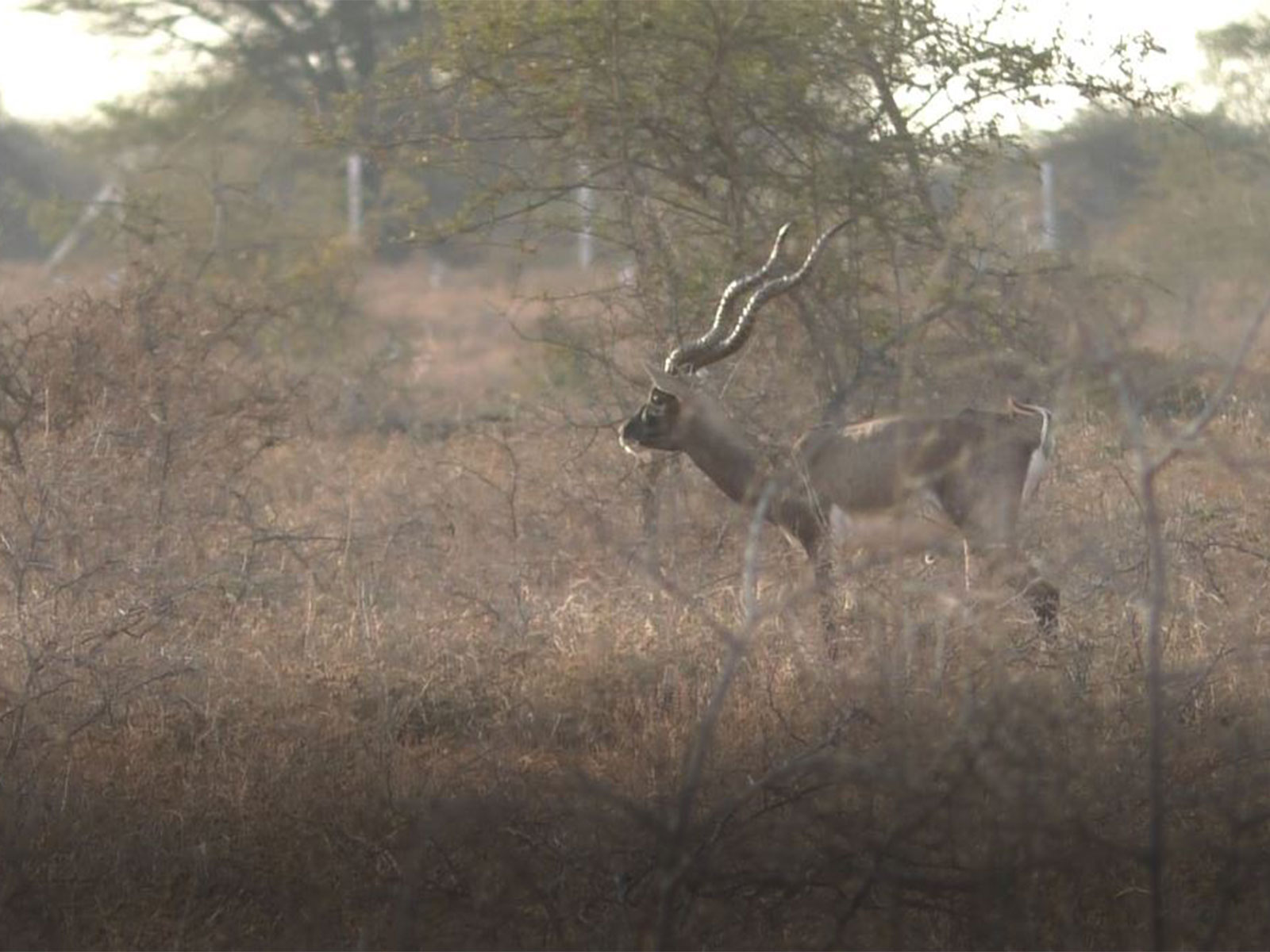
Thoothukudi (Tamil Nadu) [India], September 16 (ANI): Vallanadu Blackbuck Sanctuary, located in the Tuticorin area of Tamil Nadu’s Thoothukudi district, protects the blackbuck, scientifically known as Antilope cervicapra. Spread across about 16.41 square kilometres of dry grasslands and scrub forests, the sanctuary is one of the important natural habitats for blackbucks in southern Tamil Nadu.
The male blackbuck, known for its striking spiral-shaped horns, dark coloured body and remarkable speed and agility, remains a fascinating sight for visitors who travel to the sanctuary to observe the animals in their natural surroundings.
Apart from blackbucks, the sanctuary is home to wild boars, jackals, hares and various migratory birds. It plays a vital role in conserving the dryland ecosystems of Tamil Nadu and also serves as a site for research, education and eco-tourism, attracting visitors interested in wildlife. The protected area helps ensure the preservation of grassland biodiversity in the region.
The sanctuary was officially notified as a protected area in September 1987, with the primary objective of conserving the blackbuck antelope and its dry scrub forest habitat. Historically, blackbucks roamed freely across large parts of the Tamil Nadu plains, but increased poaching and rapid agricultural and urban expansion over the decades sharply reduced their numbers and confined the species to a handful of isolated pockets.
Today, natural blackbuck populations in Tamil Nadu survive only at a few such sites, including Guindy National Park in Chennai, Mudumalai, Point Calimere in Nagapattinam, and Vallanadu, leaving the Thoothukudi sanctuary as one of the last strongholds of the species in the state, and the southernmost point in India where a natural blackbuck population exists.
With its dry thorn forests, grasslands and open landscapes, the sanctuary offers an ideal environment suited to the needs of the blackbuck, a species that thrives in arid and semi-arid terrain rather than dense forest cover.
According to forest department data, the blackbuck population at Vallanadu has shown a steady rise in recent years, aided by habitat restoration efforts, with recent counts placing the number of blackbucks in the sanctuary in the range of a few hundred individuals. Officials have attributed the population growth to sustained conservation measures, including efforts to curb invasive vegetation and improve grazing conditions within the sanctuary.
Beyond its role in protecting the blackbuck population, the sanctuary also serves as an important natural asset for conserving the dryland ecosystem of Thoothukudi district, supporting a wide variety of other wildlife species, including spotted deer, jungle cats, mongooses and wild hares, that depend on similar habitat conditions.
Conservation efforts at the sanctuary continue to focus on preserving the delicate balance of the dry thorn forest ecosystem while ensuring the long-term survival of the blackbuck population in the region. (ANI)
Related reading