PRNewswire
Hyderabad (Telangana) [India], September 9: Indian deep-tech company Hylenr Technologies has reported evidence of elemental formation, including rare-earth species, inside engineered Lattice structure systems — opening a radically different pathway toward nucleosynthesis and strategic-material production.
The findings are part of Hylenr Technologies’ work during the last 10-plus years on Nuclear Fusion technology based on Lattice confinement fusion and have also collaborated and validated with leading international research institutions.
A part of this work, titled ‘Nuclear Signatures in a Hydrogen-Loaded Ni–Pd Lattice Confinement System,’ was presented earlier this month at the 27th International Conference on Condensed Matter Nuclear Science (ICCF-27) at Niagara Falls, Canada.
From Nuclear Energy to Nucleosynthesis
Nucleosynthesis is the process by which atomic nuclei are transformed to create different elements.
In nature, this occurs inside stars, supernovae and other extreme astrophysical environments, where enormous temperatures, pressures and energy densities drive nuclear reactions.
On Earth, producing or transforming elements through nuclear processes typically requires large-scale nuclear reactors, particle accelerators or high-energy experimental infrastructure.
Hylenr Technologies’ results demonstrate a fundamentally different pathway for nuclear processes and nucleosynthesis within engineered solid materials. In hydrogen-loaded metal lattices, interactions between hydrogen, lattice defects, vacancies and the local electronic environment create highly confined conditions capable of enabling nuclear processes within the material itself.
This shifts the idea of element formation from enormous high-energy systems toward compact, engineered Nuclear energy.
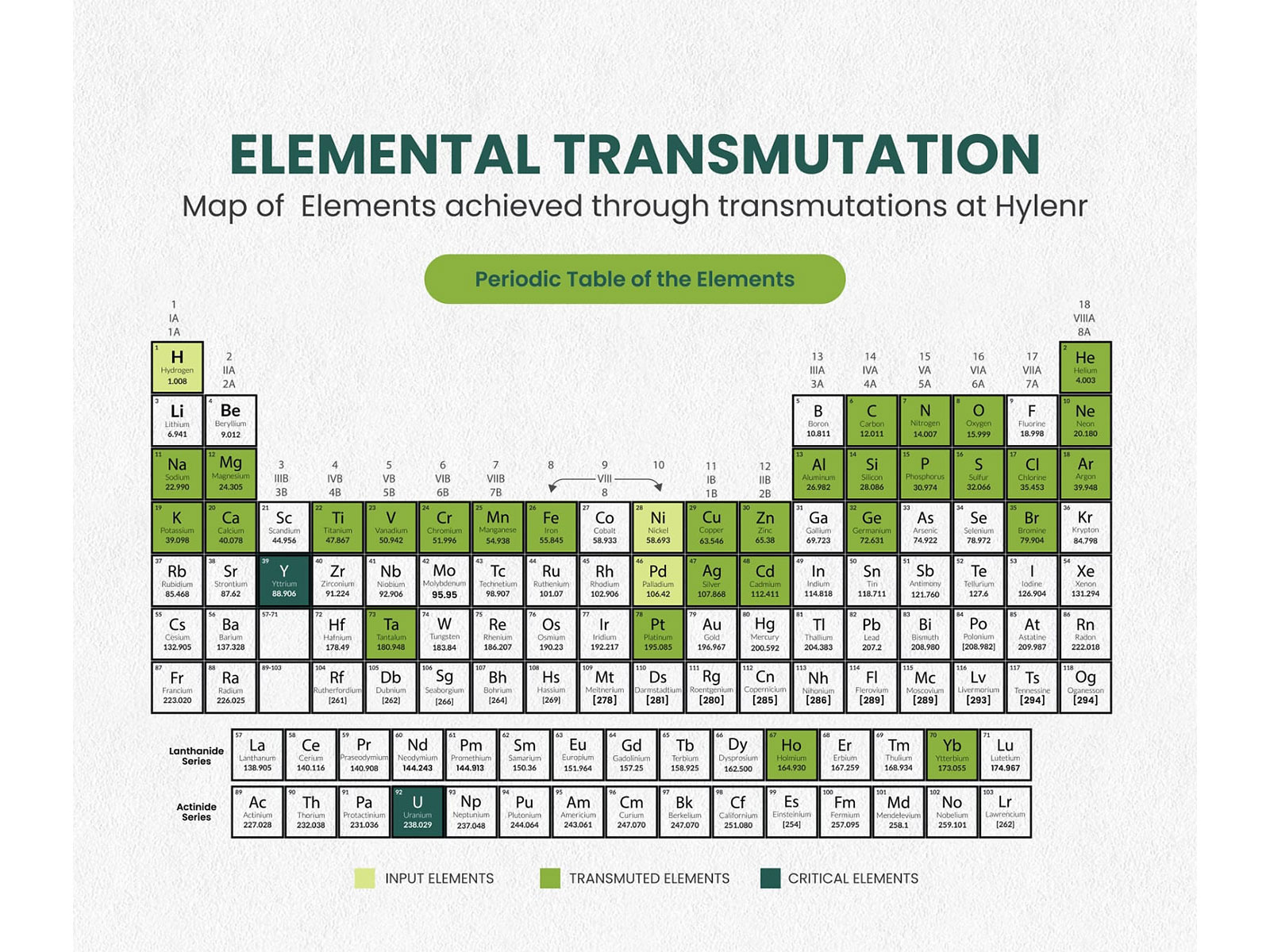
Signatures of 32 Elements Detected
Across approximately two years of material-analysis work, Hylenr Technologies has detected signatures corresponding to 32 elements in post-operation samples, spanning light elements, heavy elements, noble gases Like Helium Neon and Argon. Furthermore, strategically important rare-earth species including Yttrium, and actinides including Uranium. Signatures are reported against pre-operation baseline characterisation of the same Catalyst material sample acting as control, and each is corroborated by more than one of the independent techniques below.
The observations have been studied using multiple independent analytical techniques, including:
* Energy-Dispersive X-ray Spectroscopy (EDX)
* X-ray Photoelectron Spectroscopy (XPS)
* Inductively Coupled Plasma Optical Emission Spectroscopy (ICP-OES)
* Wavelength-Dispersive X-ray Spectroscopy (WDX)
* Residual Gas Analysis (RGA)
Made, Not Mined
Rare-earth elements sit at the centre of many of the world’s most strategically important technologies.
They are critical to permanent magnets, electric vehicles, robotics, wind turbines, electronics, aerospace systems, defence platforms and advanced manufacturing.
“Yet their global supply chain remains highly concentrated, creating strategic dependence for countries seeking to scale clean energy, defence manufacturing and next-generation electronics,” stated Ram Ramaseshan, Co-founder and Board Member, Hylenr Technologies.
Hylenr Technologies’ work points toward an entirely different model: produce selected elements through engineered nucleosynthesis rather than extract them exclusively from geological deposits.
For India, this could create a new technological pathway toward critical-material sovereignty across defence, electronics, electric mobility, renewable energy, space and advanced manufacturing.
For the world, it raises the possibility that future access to strategic elements may depend not only on where they occur naturally, but on our ability to engineer the nuclear environments within materials to create them.
“What makes this finding exciting is the possibility of bringing together Nuclear Fusion Energy and Rare Earth materials within one engineered nuclear platform,” said Siddhartha Durairajan, Co-founder and Board Member of Hylenr Technologies.
“For thousands of years, access to an element has been determined by whether nature concentrated it somewhere in the Earth’s crust. We are working toward a very different future — one in which we can engineer the material environment required to create selected elements.”
Investor Relations
(ADVERTORIAL DISCLAIMER: The above press release has been provided by PRNewswire. ANI will not be responsible in any way for the content of the same)
Related reading