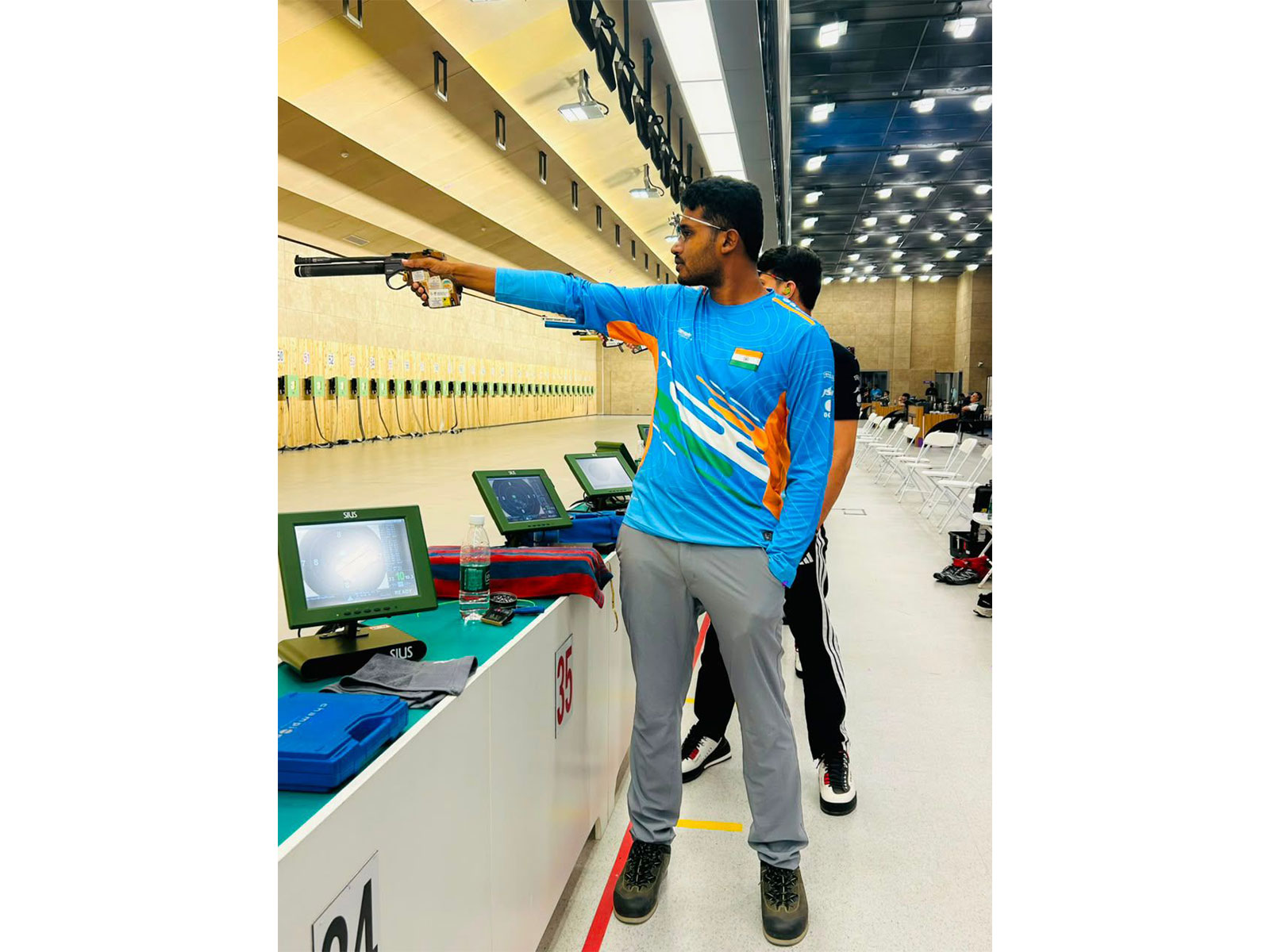
New Delhi [India], August 31 (ANI): When Kedarling Balakrishna Uchaganve joined the Indian Army in 2018, he had no grand sporting ambition. Like many youngsters from his village in Karnataka, his immediate goal was simple — to secure a job, support his family and serve the country. Shooting was nowhere on his radar.
Today, the 27-year-old Naib Subedar of the 27 Madras Regiment is preparing to represent India at the Asian Games, having discovered the sport only after joining the Army. And while the Asian Games will mark the biggest chapter of his journey so far, Kedarling already has his eyes on an even bigger dream — winning an Olympic medal at Los Angeles.
Coming from a small village in Karnataka, Kedarling grew up in a family whose livelihood is rooted in agriculture. His parents continue to work in farming, while he grew up in a joint family with his siblings, grandparents and extended family. Sporting ambitions were not necessarily part of his early life. As a youngster, he had participated in running events, including the 1500m at the district level, but never imagined that one day he would represent India on an international sporting stage.
His introduction to shooting was almost accidental.
“I did not know much about shooting before joining the Army. I had only heard the name of Abhinav Bindra during school or college because it would come up in general knowledge. When I joined the Army in 2018, I discovered that there was a shooting range and that talent was being identified. I was selected, and that was when I really came to know about shooting,” Kedarling recalled, as quoted by a press release from the National Rifle Association of India (NRAI).
The first time he picked up a pistol was during the Army’s selection process. Initially, there was little understanding of where the sport could take him. But exposure to competitions, senior shooters, coaches and motivational programmes gradually changed his perspective.
“Initially, we did not have much information about the sport. We would just train with the gun. But when we started getting outdoor exposure, watching shooting-related videos and going to domestic competitions, we began to understand that this could actually become a career. We could do our job and also play for the country. That is when the desire started,” he said.
The sport also appealed to him for its unique demands. Unlike the running events he had participated in as a youngster, pistol shooting offered a completely different challenge — one where concentration, composure and precision could determine the outcome.
“I liked that it is an indoor sport and there are no external factors like running. You have to control yourself and focus on your grouping. I started enjoying it,” he said.
The Army soon became more than just his workplace. It became the ecosystem in which his shooting career took shape. His basic coaches encouraged him to pursue the sport, and after he made the Army team, he found access to a larger support system comprising coaches, sports medicine professionals and nutrition staff.
The Army also provided him with his first pistol. As his performance improved, he was given an individual weapon after initially training with shared equipment. Today, Kedarling continues to retain the Army-issued pistol while also having invested in a spare pistol himself.
His journey has not, however, been without challenges. Coming from an agriculture-dependent family, finances were a consideration, particularly in a sport where equipment and ammunition can be expensive. While the Army has been a significant pillar of support, Kedarling has also tried to contribute towards his family’s needs.
“Earlier, whenever there was a need at home, I would tell my father that whatever I could manage, I would provide. I would take care of the rest myself. Things are better now,” he said.
His sporting journey has also received support from the National Rifle Association of India (NRAI), the Sports Authority of India (SAI), and his sponsor, helping him access competitions, camps, support staff and other requirements.
For Kedarling, the support he receives from the national shooting set-up is as much about the environment as it is about resources.
“NRAI has been very supportive throughout my journey. Whenever we have to go for competitions, camps or international events, they make sure that the necessary support is available. The entire team environment is very positive, and everyone is working together. If I have any issue, I first speak to our coach, and it gets taken forward to the concerned level. The support is always there to find a solution,” he said.
Interestingly, Kedarling begins his day with meditation, focusing on his breathing and staying in the present — a routine that mirrors the fundamental demands of his sport. “First of all, if we stay calm, everything will be fine. During meditation, I focus on my breathing and on the situation, so that I can stay in the present. That helps me.”
His philosophy towards competition is equally uncomplicated — execute what he has trained for and let the result take care of itself. “My aim is the same in every competition — to bring medals for the country. We have a strategy and a training routine. We have to execute that properly. If we follow our routine and execute our training in the right way, the medal will come automatically.”
Being selected for the Asian Games is already his most special achievement.
For his family back home, however, the significance is perhaps simpler. They know he is going to compete abroad and represent India, but Kedarling says they do not always understand the intricacies of scores, rankings and international shooting.
“They are very happy that their son is going to another country for a competition. Coming from a village, getting a job and then getting an opportunity to go abroad is a big thing. They just tell me to do well, take care of myself and have faith in God,” he said.
The news has travelled beyond his family too. People in his village now know that the youngster who left home to join the Army has become a shooter representing India. Some parents have even told him that their children want to follow a similar path.
Yet, Kedarling insists he does not carry the weight of expectations from his village, his Army unit or the country.
“There is no pressure. If I perform well, everything will happen automatically — the country’s name, my village’s name and the Army’s name. My main focus is to stay in the present and execute what I have learned and trained for,” he said.
“My mantra is — Just be patient. You will get what you want in time. Don’t run ahead of time. Whatever you are working hard for, you will get it in time,” he added.
That patience has taken him from a Karnataka village to the Army shooting range, from picking up a pistol for the first time in 2018 to competing at a senior World Cup in 2022, and now to the Asian Games.
But Kedarling is not looking at the Asian Games as the destination. His ultimate goal is Los Angeles. “My main goal is the Olympics. I want to go to the Olympics in Los Angeles and win a medal,” he signed off. (ANI)
Related reading