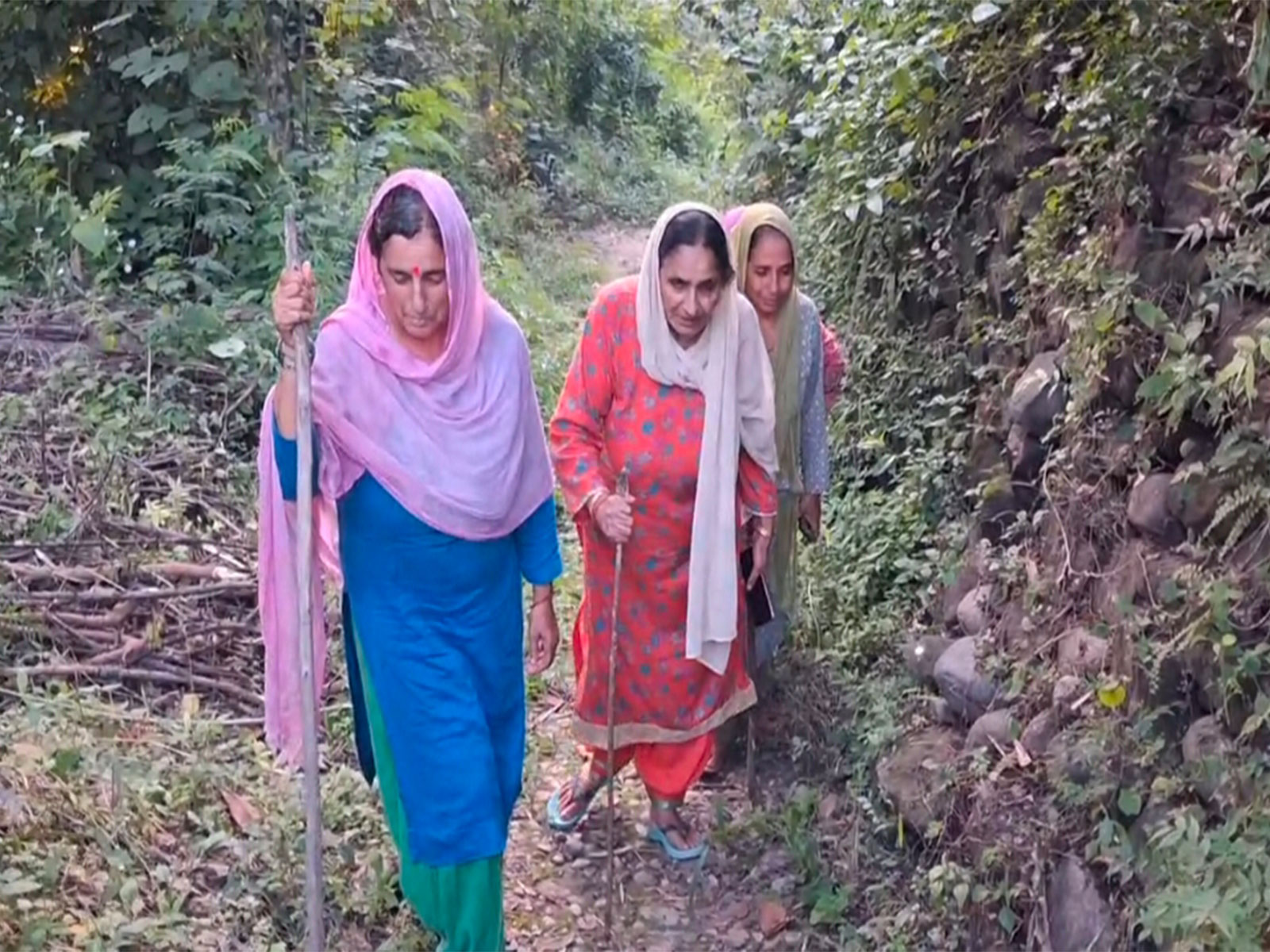
Hamirpur (Himachal Pradesh) [India], August 29 (ANI): As Raksha Bandhan brought families together across Himachal Pradesh, women in Chief Minister Sukhvinder Singh Sukhu’s home district of Hamirpur were forced to undertake a difficult journey over steep and rugged village tracks to meet their brother once again, highlighting the long-standing road connectivity problem faced by residents of Badhar village.
The Badhar Village sisters walk difficult terrain to reach their brother on Raksha Bandhan; a 75-year-old woman is unable to make the journey, while villagers seek an urgent ambulance road.
For nearly 150 residents of Badhar, reaching the nearest motorable road remains a major challenge. The issue becomes particularly poignant during festivals such as Raksha Bandhan, when sisters have to negotiate difficult stretches on foot to reach their brothers and relatives.
This Raksha Bandhan, 60-year-old Sushma Devi from far-away Amned village and 58-year-old Meera Devi from Bohni village braved the harsh tracks to reach the house of their 55-year-old brother, Rakesh, in Badhar.
The journey, undertaken to maintain a cherished family tradition, has also brought renewed attention to the villagers’ demand for a proper motorable road and, in particular, an ambulance road connecting Badhar with the existing road network.
Speaking to ANI, Sushma Devi said that the experience had given a different meaning to her Raksha Bandhan celebration.
“Every Raksha Bandhan, my brother promises to protect me. This year, I want to give him a Rakhi with one simple request: that a proper road would be the most meaningful Raksha Bandhan gift from the government,” she said.
Meera Devi also appealed to the government, saying that the village urgently needs safe ambulance access.
“This Raksha Bandhan, I am not asking for jewellery or sweets; I am requesting the government to give my brother and his family a safe ambulance road,” she said.
The emotional hardship was even more pronounced for 75-year-old Kashmiran Devi of Badhar, who could not undertake the difficult journey over the village tracks this year to tie Rakhi on her brother, Colonel Suresh Chauhan’s hand.
Her inability to make the journey, residents said, underlined how the lack of road connectivity disproportionately affects elderly people and those with limited mobility.
The road issue has acquired added significance because Hamirpur is the home district of Chief Minister Sukhvinder Singh Sukhu. Residents say that despite being located in the Chief Minister’s home district, Badhar continues to struggle with basic road connectivity.
Local youth and villagers have urged the district administration and elected representatives to give priority to the construction of an ambulance road so that emergency medical cases can be transported without the delays and physical hardship currently associated with reaching the main road.
They say the demand is not for a luxury facility but for basic infrastructure necessary for safety, healthcare and the continued habitation of the village.
Residents point to two deaths in the past two years as a grim reminder of the consequences of poor connectivity.
According to villagers, Captain DS Patyal and Suresh Kumar died during medical emergencies while being evacuated towards the main road.
Residents allege that the difficult terrain and absence of direct motorable access made the evacuation process challenging and resulted in the loss of crucial time during medical emergencies.
They fear that another serious medical emergency could again become a race against time.
An ambulance road, they say, would not only facilitate medical evacuation but also improve access for fire services, government vehicles and other essential services.
The connectivity problem extends beyond emergency healthcare.
Students from Badhar have to negotiate difficult terrain to reach schools and colleges, while young people seeking higher education, vocational training and employment opportunities face additional hurdles because of the lack of convenient transportation.
Farmers also face difficulties transporting agricultural produce to markets. The absence of a motorable road increases transportation costs and makes it harder for small farmers to market their produce profitably.
For elderly residents, routine visits to hospitals, markets and government offices can involve considerable physical effort.
Residents say the roadless condition has effectively increased their distance from essential public services.
Villagers also blame poor connectivity for contributing to the gradual migration of families from Badhar.
Several families have reportedly moved away from their ancestral homes in search of better access to healthcare, education, employment and transportation.
Local youth fear that continued migration could accelerate the depopulation of the village, leaving behind an ageing population and abandoned houses.
They believe improved road connectivity could encourage families to remain in the village and provide younger residents with better access to education and employment opportunities.
Local youth have proposed a coordinated approach to overcome the hurdles in constructing the road.
They have suggested voluntary land pooling, obtaining no-objection certificates from landowners, convergence of different government schemes and expediting forest-related permissions wherever necessary.
The villagers say a PWD-standard road should be the long-term objective, while an ambulance road could be prioritised as an immediate intervention.
They believe better connectivity would have benefits beyond transportation, improving healthcare access, education, agriculture, digital connectivity, skill development, employment opportunities and the potential for local tourism.
For the women who walked the difficult tracks this Raksha Bandhan, the journey was about more than simply reaching their brother’s house.
Sushma Devi and Meera Devi were able to reach their brother Rakesh and celebrate the festival. But 75-year-old Kashmiran Devi could not make the journey to tie Rakhi on her brother Colonel Suresh Chauhan’s wrist.
Their experiences have given a human face to Badhar’s long-standing demand for road connectivity.
The villagers say they want a road that allows an ambulance to reach a patient in an emergency, enables children to travel safely to school, allows farmers to transport their produce and ensures that elderly residents can move without having to negotiate dangerous terrain.
With Badhar located in the Chief Minister’s home district, residents now hope that their appeal will receive urgent attention and that the government will turn their Raksha Bandhan plea into concrete action.
For the people of Badhar, they say, the most meaningful Raksha Bandhan gift would be a road that brings their village closer to the rest of the state. (ANI)
Related reading