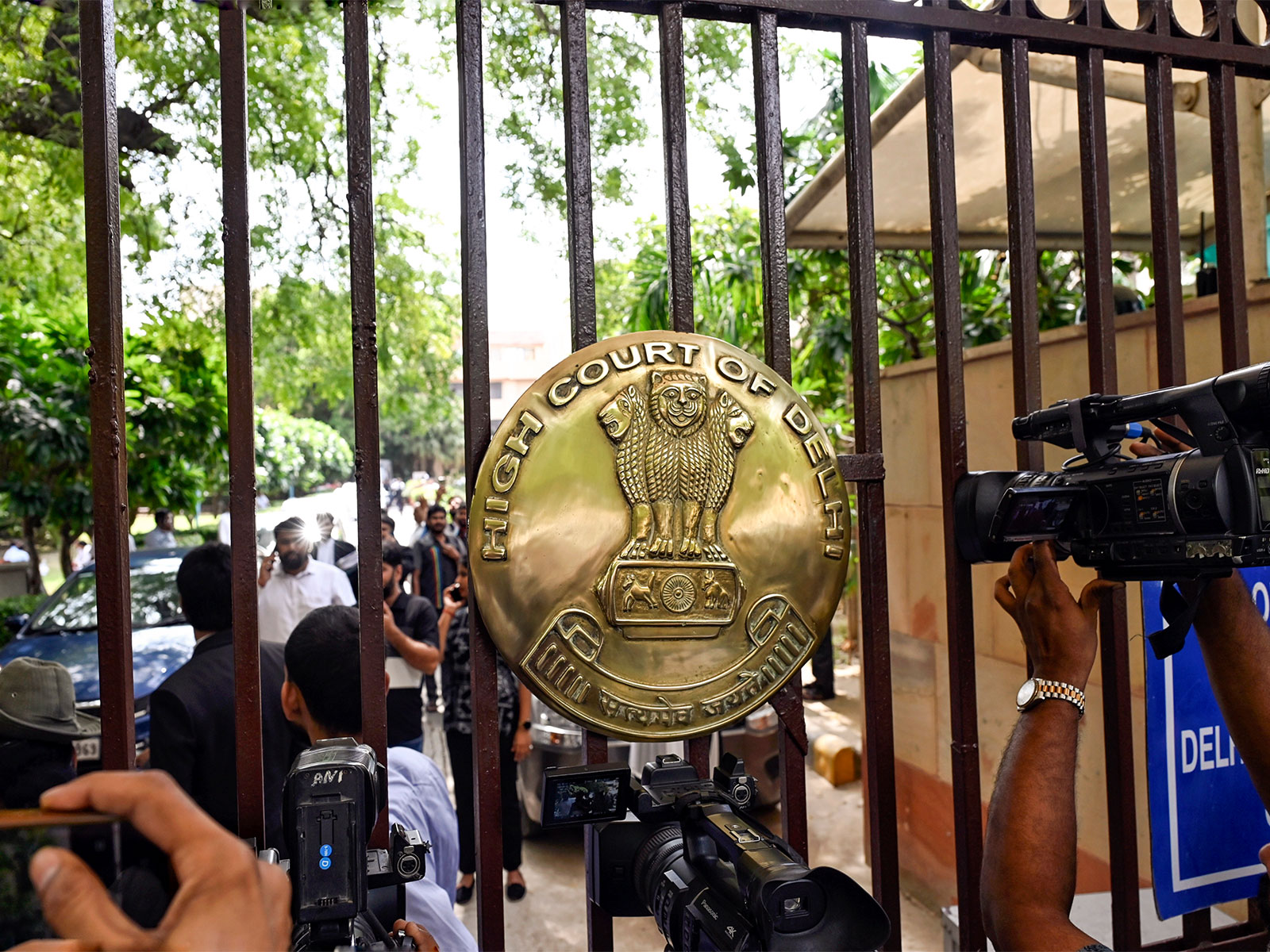
New Delhi [India], August 25 (ANI): The Delhi High Court has expressed serious concern over untreated sewage continuing to flow into the Yamuna and observed that several gaps in Delhi’s sewage management system need to be addressed to prevent further pollution of the river.
The Court also took strong exception to the condition of the open Abul Fazal drain in Okhla, observing that it was running without protection and could pose a “serious safety hazard” to residents and commuters.
A Division Bench of Justices Prathiba M. Singh and Manmeet Pritam Singh Arora, in an order dated August 24, directed the authorities to step up measures relating to sewage treatment, drainage and redevelopment of industrial areas, stressing that untreated sewage must not directly reach the Yamuna.
The Court identified four key issues concerning sewage treatment plants (STPs): upgrading existing plants, augmenting their capacity, setting up new STPs to ensure untreated sewage does not flow directly into the river, and ensuring that treated water does not again mix with untreated sewage before reaching the Yamuna.
The Bench particularly took note of reports by Local Commissioners that only some of the sewage was being treated, while other sewage was flowing into the river without treatment. The Court recorded that the Delhi Jal Board (DJB) proposed setting up 13 decentralised sewage treatment plants with a combined capacity of 328 MGD to address this problem.
The detailed project reports for these proposed plants have been prepared and sent to the Namami Gange Project Authority. The Court directed the Director General of the National Mission for Clean Ganga (NMCG) to look into the proposal.
The Court was also informed that Delhi currently has 28 upgraded STPs with a combined capacity of 735 MGD, which are operational at the 10/10 standard prescribed by the National Green Tribunal. Nine other STPs are undergoing upgradation and are currently operating at the 30/50 standard, with the work targeted for completion between December 2027 and May 2028.
Besides this, work has been awarded for 28 of 29 decentralised STPs proposed for the outer areas of Delhi, while one is at the tender stage. Their construction is targeted for completion by January 2028.
The Bench, however, highlighted another critical concern: treated water itself could get mixed with untreated sewage. It directed that drains for carrying treated water should be given “top priority” while planning works for both existing STPs and the newly proposed plants.
The DJB has stated that the total capacity of existing STPs stood at 814.26 MGD as of August 24, 2026, and that it seeks to increase this to 1,041.10 MGD by December 31, 2027. Further plants could be commissioned depending on project reports and availability of funds.
While examining waterlogging in the Okhla area, the Court also expressed “extreme concern” after examining photographs of the Abul Fazal drain, which showed the open drain running without adequate protection.
The Bench noted that an uncovered drain without a separator wall or covering could pose a serious safety hazard to residents and commuters.
The Court had earlier directed the MCD to construct a separator wall between the drain and the road carrying vehicular traffic and install reflectors and lights to make the drain visible to pedestrians and drivers.
The MCD informed the Court that lights and reflectors had already been installed, but the separator wall had not been constructed because the Uttar Pradesh Irrigation Department had not issued an NOC.
The Court noted that the MCD had already written to the concerned Executive Engineer on April 24, May 12 and July 3, 2026, seeking the NOC, but no response had been received. It was also informed that the budget for the separator wall had already been sanctioned.
In view of the danger to local residents, the Bench directed the MCD to immediately construct the separator wall and cover the open drain with slabs, if required in accordance with law, without waiting for any further NOC.
The Court further directed the MCD to undertake continuous desilting of the drain and clean the surrounding area, noting that the photographs showed a large quantity of litter and garbage in and around the drain.
The Court also dealt with redevelopment of 27 non-conforming industrial areas, observing that their redevelopment was “absolutely essential” to ensure that untreated sewage does not flow into the Yamuna and to eliminate waterlogging.
Plans for 25 such areas have moved between DSIIDC, MCD and DDA, but the process has reached a stalemate over requests for relaxation of certain Master Plan norms.
The Bench directed Additional Commissioner (Planning), DDA, Manish Verma, to convene a meeting with all concerned authorities on August 31 and prepare clear timelines for approval of plans and consideration of required relaxations.
The Court observed that these industrial clusters had existed for several decades without proper infrastructure or planning and said that imposing newly introduced conditions under fresh Master Plans would be “completely impractical”. It called upon the DDA to adopt a pragmatic approach so that essential infrastructure, including drains, water pipes and sewage lines, could be created in these areas.
For Samaypur Badli, the Court directed the authorities to consider subsequent zonal plans and notifications while demarcating the entire area and preparing a fresh redevelopment plan. A meeting has been fixed for September 2, following which the concerned agency has been directed to prepare the fresh plan within three months.
For Phirni Road, the Court directed the competing industrial associations to submit their comments by August 31. The redevelopment plan is to be finalised and submitted to the MCD by September 30.
The Court will next take up issues concerning Common Effluent Treatment Plants and the interplay between water and air pollution on September 25, 2026. (ANI)
Related reading