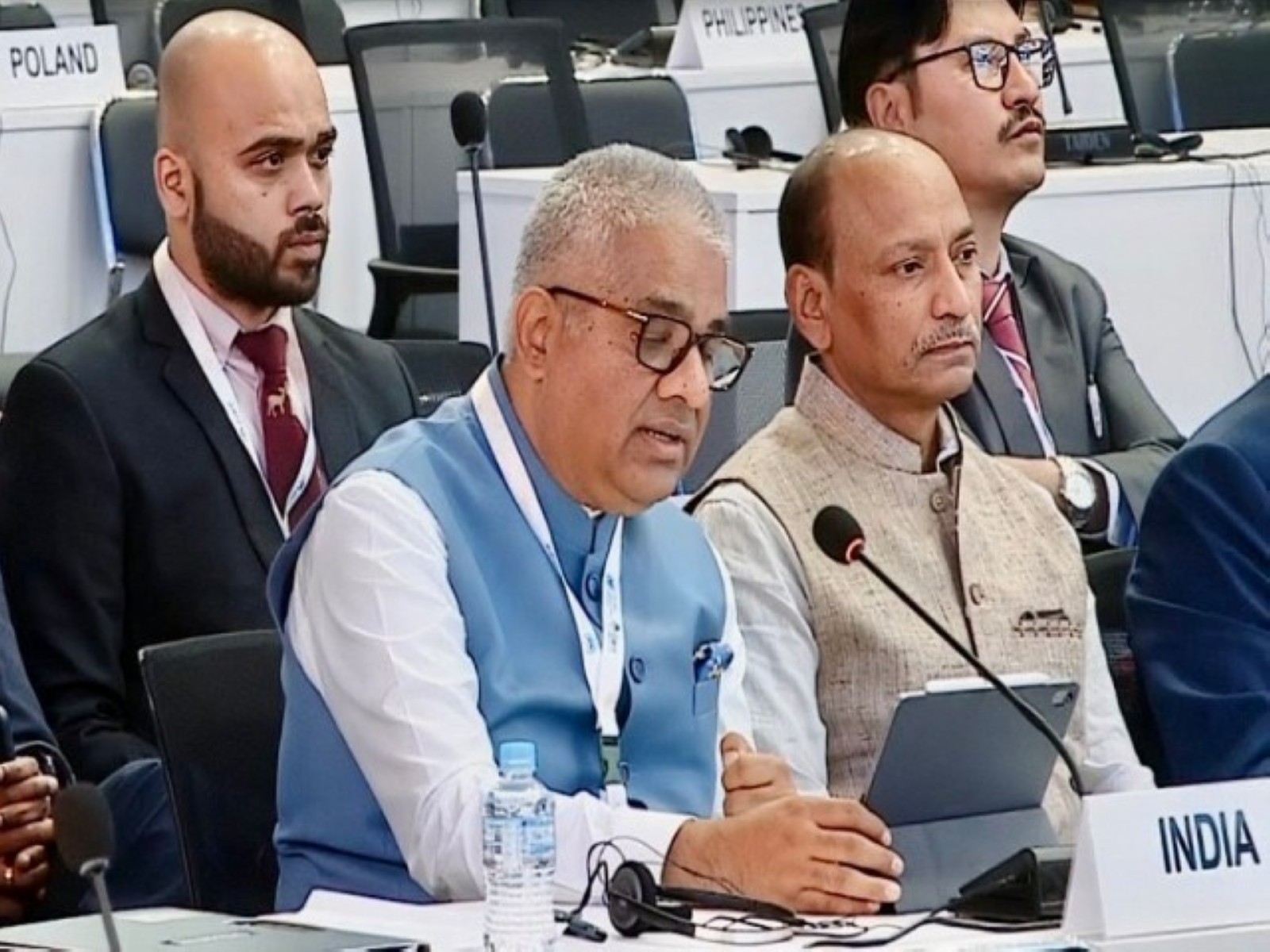
Ulaanbaatar [Mongolia], August 25 (ANI): India highlighted its best practices and how it is pushing for a fundamental shift in the global approach to drought – from reactive relief to proactive, technology-enabled resilience at the Ministerial Dialogue on ‘Accelerating Drought Resilience’ at COP17 of UNCCD in Ulaanbaatar, Mongolia.
Speaking at the event, Union Minister for Environment, Forest and Climate Change Bhupender Yadav presented India’s views at the dialogue, underlining how drought is no longer an occasional event, but a defining developmental challenge touching water security, food systems, biodiversity and economic stability. He highlighted that India integrates early warning, mitigation, relief and community resilience through a coordinated multi-institutional approach.
He noted of India’s practices, such as rainfall tracking and satellite-based drought assessments, and how a risk-informed approach rests on the premise that land sustains water.
He also highlighted the rejuvenation of traditional water bodies as an important tool for strengthening groundwater recharge and rural resilience. In India’s mountainous regions, community-led restoration of springs and recharge zones is helping secure water for drinking and irrigation, he underlined.
In the plains, Union Minister Yadav pointed to India’s watershed development programmes, which address degraded rain-fed landscapes through a ridge-to-valley approach. These initiatives, he said, are driven by community institutions and strengthened through convergence with rural employment programmes.
“At the household level, drinking water programs ensure reliable supply even under stress with assured service levels, local quality testing and prioritization of vulnerable areas,” he added.
He highlighted how India’s core belief is that drought must be managed as a predictable, preventable risk and not a recurring disaster demanding emergency response.
“Prevention rests on watershed development, water harvesting, up-forestation, recharge and climate-resilient crops, disaster-related funds, employment guarantees, fodder support and emergency water supply provide relief when required,” he said at the dialogue.
He also highlighted the role of crop insurance in protecting farmers from drought and other non-preventable losses across the crop cycle. Technology-driven assessment, combined with subsidised insurance premiums, can help make claims faster and more transparent, he said.
“A crop insurance scheme that financially protects farmers against drought and other non-preventable losses across the crop cycle, combining subsidized premises with technology-driven assessment, ensures faster, transparent claim statement. Building drought resilience is not optional for the world’s most vulnerable; it is survival,” he underlined.
In his remarks, he reiterated that India stands ready to share its knowledge and capacities including on early warning for a broad resilient future for all.
https://x.com/byadavbjp/status/2092160419809104136
Earlier on Monday too, at the 17th Conference of Parties (COP17) to the United Nations Convention to Combat Desertification (UNCCD) in Ulaanbaatar, India made a strong pitch for diversified, adequate, and predictable international finance for land restoration and drought resilience, even as global stakeholders announced a USD 1.3 billion financial package centred on restoring the world’s critical rangelands. (ANI)
Related reading