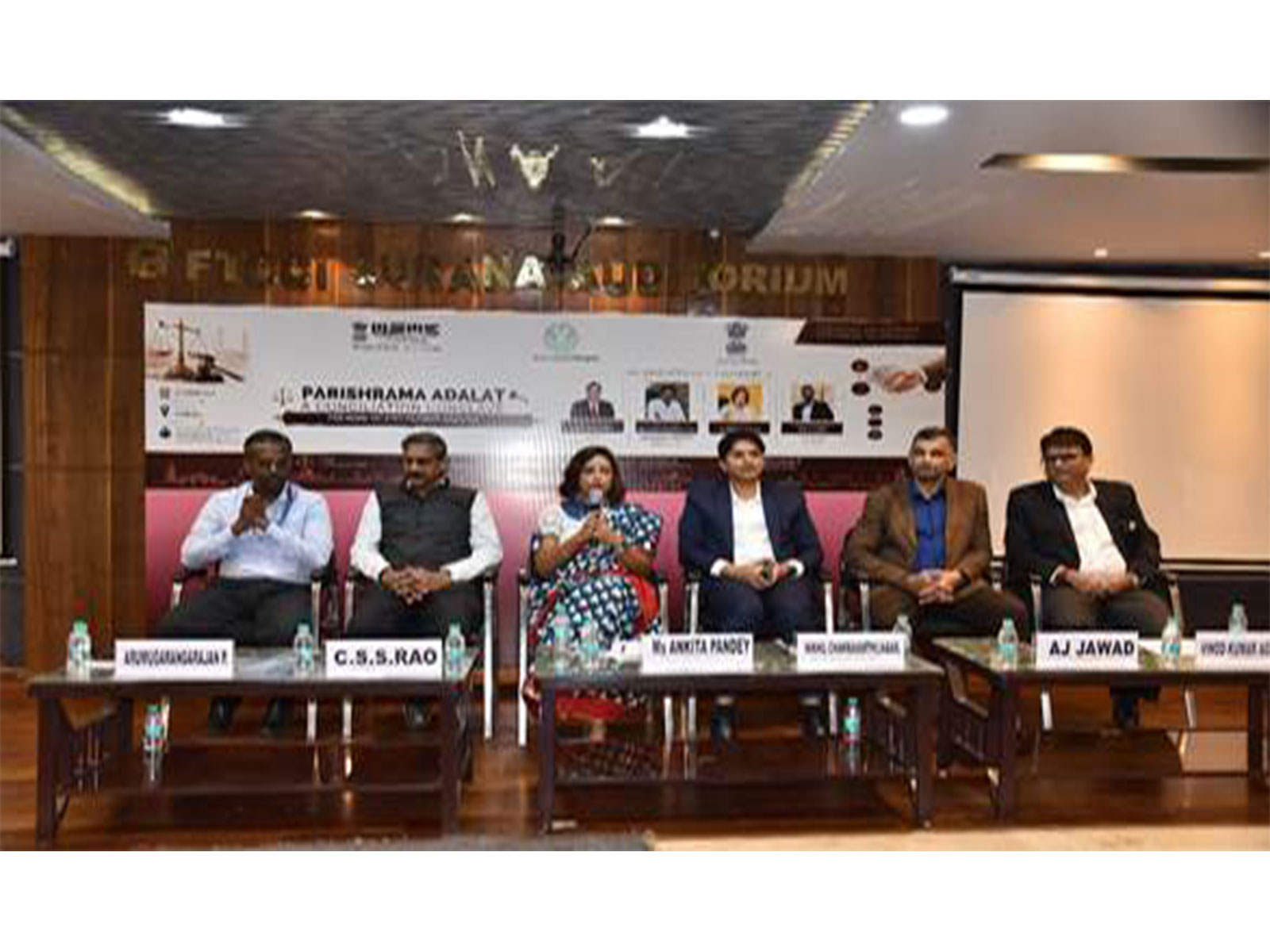
New Delhi [India], August 25 (ANI): The ‘Parishrama Adalat’, a Conciliation Conclave for Micro and Small Enterprise (MSE) delayed-payment disputes, organised by the Commissionerate of Industries and Commerce, Government of Telangana, in association with the Ministry of Micro, Small, and Medium Enterprises (MSME), successfully resolved 65 delayed-payment cases involving ₹8.29 crore.
Held at FTCCI, Hyderabad, the conclave brought together MSEs, buyers, public sector enterprises, MSE Facilitation Councils, ADR institutions and officials from the Ministry of MSME and the Government of Telangana.
According to the press release by the Ministry of MSME, for an MSE, a delayed payment is not merely an unpaid invoice. It can affect salaries, purchase of raw materials, repayment of loans and the ability to take up new business opportunities. The Parishrama Adalat highlighted how timely and effective dispute resolution can support business continuity, restore confidence and strengthen commercial relationships.
Shalini of Neemus Software Solutions Pvt. Ltd described prolonged delayed payments and contract-related disputes that had drained the enterprise’s savings and confidence. Through the delayed-payment mechanism, the enterprise resolved nine out of eleven cases. Her experience highlighted the wider meaning of payment recovery–the restoration of confidence to continue operating and growing.
Mukund Maheshwari of Nagarjuna Agro Chemicals Pvt Ltd shared how intervention by the Council helped clear an outstanding amount from a buyer who had earlier avoided his calls. Beyond recovery of the payment, the commercial relationship survived. He stated at the event, “Cash flow is the oxygen of industry.”
Atmakuri Nammalwar of Sree Solutions described waiting for more than two years for dues. Through the dispute-resolution mechanism, the enterprise reported recovery of close to ₹30 lakh, with four cases closed within approximately two to three months.
A case from Karimnagar highlighted the importance of accessible dispute-resolution mechanisms. A person with disability running a home-pipes business was able to pursue resolution of approximately ₹11 lakh in delayed payments. The case underscored the importance of ensuring that the circumstances of an entrepreneur do not become barriers to seeking a remedy.
Hyderabad Ammonia & Chemicals Pvt Ltd faced delayed payments of nearly ₹79 lakh from nine buyers, putting pressure on its cash flow. Through the ODR Platform, three conciliation meetings helped bring the parties together. One major buyer settled ₹20 lakh, while other buyers also began clearing their dues. The company reported recovering ₹54 lakh in total, the release said.
Gopi Krishna of Shabari Industries shared how delayed payments had begun affecting the enterprise’s credit profile. The mechanism helped the enterprise realise approximately ₹40 lakh in two payments. Ranjith Reddy of A P Engineering shared that three cases were resolved through ODR, while Sri Srinivasulu of Panduranga Enterprises spoke of a long-delayed matter involving approximately ₹16 lakh that moved towards settlement.
The ODR platform, launched in 2025, brings technology into the dispute-resolution process and provides a digital pathway through which delayed-payment matters can be taken forward, while the institutional role of MSE Facilitation Councils remains central to resolution.
Ankita Pandey, Director, RAMP, Ministry of MSME, traced the evolution of the delayed-payment framework from the Samadhan Portal to the MSME ODR platform. Figures shared during the programme indicated that more than 800 cases had been filed in Telangana through the ODR ecosystem, with around 85 resolved.
Nikhil Chakravarthi, Commissioner of Industries, Government of Telangana, placed the initiative within the State’s wider MSME agenda and underlined technology and institutional strengthening as instruments for improving ease of doing business.
The Parishrama Adalat reinforced that the measure of a dispute-resolution system is not simply how many files it processes, but how many businesses it helps move forward. By bringing together conciliation, institutional mechanisms and digital tools, the initiative seeks to reduce the distance between an entrepreneur, a legitimate claim and a possible resolution. (ANI)
Related reading