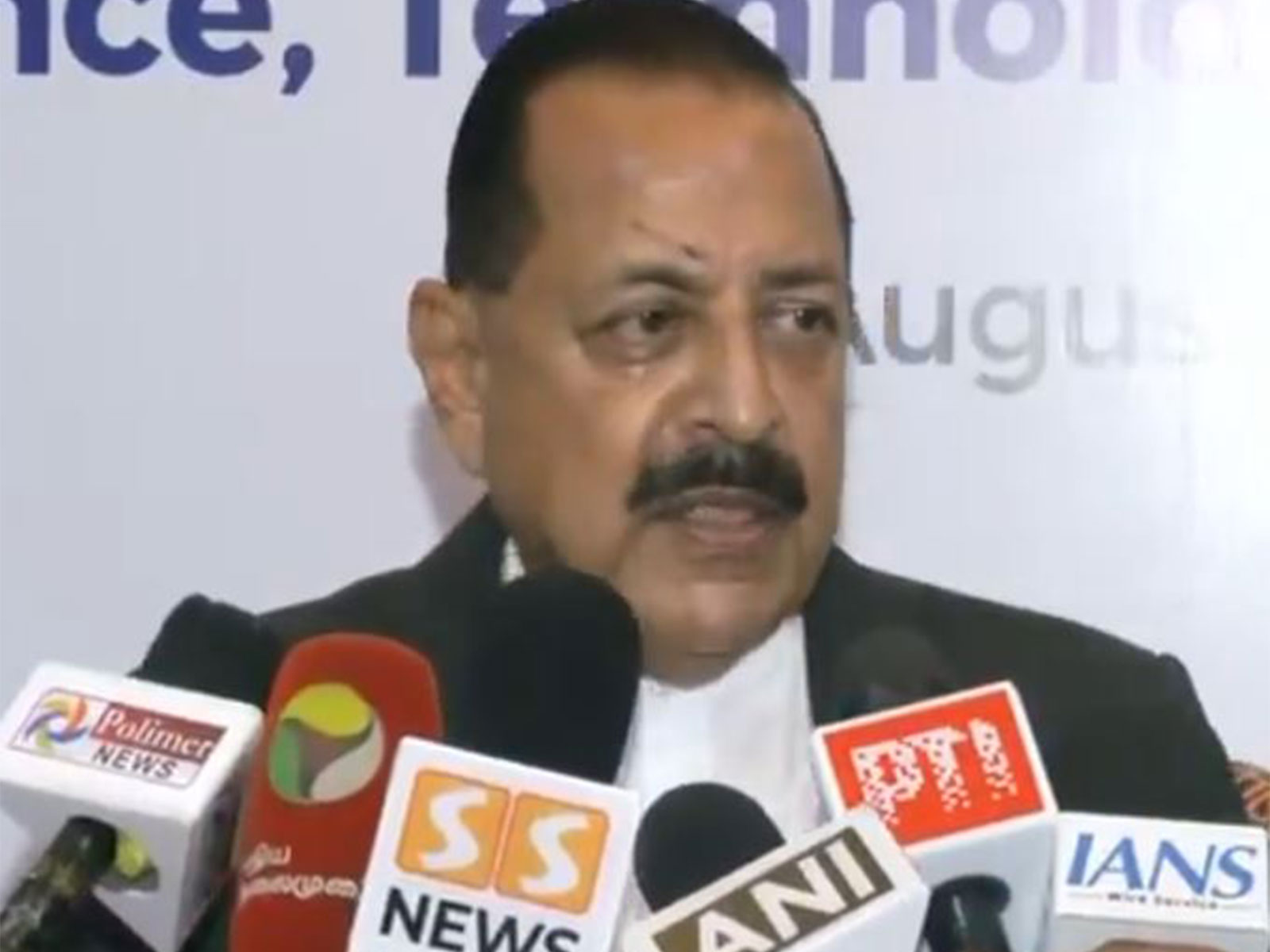
New Delhi [India], August 24 (ANI): Union Minister for Science and Technology Jitendra Singh on Monday hit back at Congress leader Jairam Ramesh’s allegation of ISRO being “strangulated and emasculated” and said Indian Space Research Organisation’s legacy is “not being diluted” but is bearing fruit under the Modi government.
Responding to Congress leader Jairam Ramesh’s remarks in which he accused the government of pursuing an “aggressive privatisation agenda for the space programme”, Jitendra Singh gave detail of the progress made in space sector in the past 12 years and said the “model is ISRO and industry together” and “they are writing the next chapter of India’s space story”.
Jitendra Singh, who is Minister of State for Space, accused Jairam Ramesh of trying to run down achievements of the government.
“You and others of your ilk seem determined to run down every Indian achievement and cast doubt on every step forward. India’s space programme is the latest target — but the facts tell a very different story. Under PM Narendra Modi, India’s space sector has taken a global trajectory by expanding from a predominantly government-led programme into a wholesome ecosystem integrating ISRO, industry and space startups. India’s space programme is not being scaled back,” he said.
Jitendra Singh said India has an ambition of 50 launches a year.
“It is being scaled up. Let us be clear on facts with evidence. ISRO is not being weakened. It is being enabled to concentrate increasingly on the frontier missions – Gaganyaan, Chandrayaan-4, the Bharatiya Antariksh Station, and future missions to the Moon, Venus and Mars. At the same time, as India moves towards an ambition of 50 launches a year, Industry has to become the manufacturer at scale, while ISRO develops the next generation of technologies and missions,” he said.
“This is the natural evolution of India’s space programme. Indian industry has always been an important partner of ISRO. Today, our youth is developing their own rockets and satellites, building their own infrastructure, raising private capital and running their own space programmes. The clearest example came on 18 July this year, when Skyroot Aerospace’s Vikram-1 reached orbit, the first privately-developed Indian rocket to do so. That is not ISRO’s legacy being diluted. That is ISRO’s legacy bearing fruit. That is how India will scale,” he said.
The Union Minister said that if India is to build a USD 44-billion space economy, “we need many things happening simultaneously: ISRO research in the frontier technologies, private rocket factories, satellite manufacturing facilities, dedicated assembly, integration and testing infrastructure, commercially operated launch facilities, and a much deeper supply chain”.
He said Sriharikota will remain at the heart of ISRO’s major launch programmes, including PSLV, LVM3 and human spaceflight.
“Kulasekarapattinam will add capacity and provide a dedicated ecosystem for the rapidly growing small-launch sector. And the results of this comprehensive space strategy are already visible: Foreign satellites launched by ISRO have risen from 35 before 2014 to more than 430 today; India has gone from a handful of space startups to more than 440; Private investment in the sector has increased sharply; NSIL has grown into a multi-thousand-crore commercial space enterprise; Chandrayaan-3 made India the first country to soft-land near the Moon’s south polar region; And in July 2026, an Indian private company reached orbit with an indigenously developed rocket for the first time,” he said.
“That is not ISRO versus industry. The model is ISRO and industry together. Together, they are writing the next chapter of India’s space story,” the minister added.
Jairam Ramesh, in his post on X, said the steps taken by government have “raised legitimate concerns” given ISRO’s capacities built up methodically and painstakingly over the past six decades.
“There have been news reports in the past couple of days on ISRO’s future role in our country’s space programme. This has raised legitimate concerns given its capacities, capabilities, and competencies built up so methodically and painstakingly over the past six decades thanks to the vision, dedication, and leadership of Vikram Sarabhai, Satish Dhawan, Brahm Prakash, UR Rao, APJ Abdul Kalam, and so many other distinguished scientists and technologists. It is abundantly clear that like in nuclear energy, the Modi Govt has an aggressive privatisation agenda for the space programme as well,” the Congress leader said.
He alleged that the “motivation is clearly coming” from the PM and his PMO itself.
“ISRO’s presence in rocket development and manufacture is to be severely limited and much of its satellite-related assets are to be transferred lock, stock, and barrel to private companies. It will also be handing over to a private company the second spaceport coming up in Tamil Nadu for which it is investing something like Rs 1000 crores. Given the winds of change, the future of the historic Sriharikota spaceport in Andhra Pradesh is itself anybody’s guess,” he added.
Jairam Ramesh said ISRO has done India enormously proud and the Prime Minister himself has basked in the glory of its achievements on multiple occasions.
“Space startups certainly deserve encouragement and support. But why should ISRO, which has for long had productive partnerships with the private sector, now be strangulated and emasculated? Already, in the past few months 100-120 key ISRO professionals have quit, perhaps seeing the writing on the wall. It is noteworthy that a distinguished former ISRO Chairman who had joined the BJP in Oct 2018 after having been inspired by the PM has also just expressed his serious doubts on the new privatisation drive involving ISRO. Why don’t the five other living eminent Chairmen also speak out on this vital issue?” he said.
Congress leader Pawan Khera had on Sunday accused the government of weakening ISRO and promoting privatization.
“Irony has left Earth’s orbit. The person who screamed that Congress would sell your Mangalsutra has now gone ahead and sold ISRO itself,” he said. (ANI)
Related reading