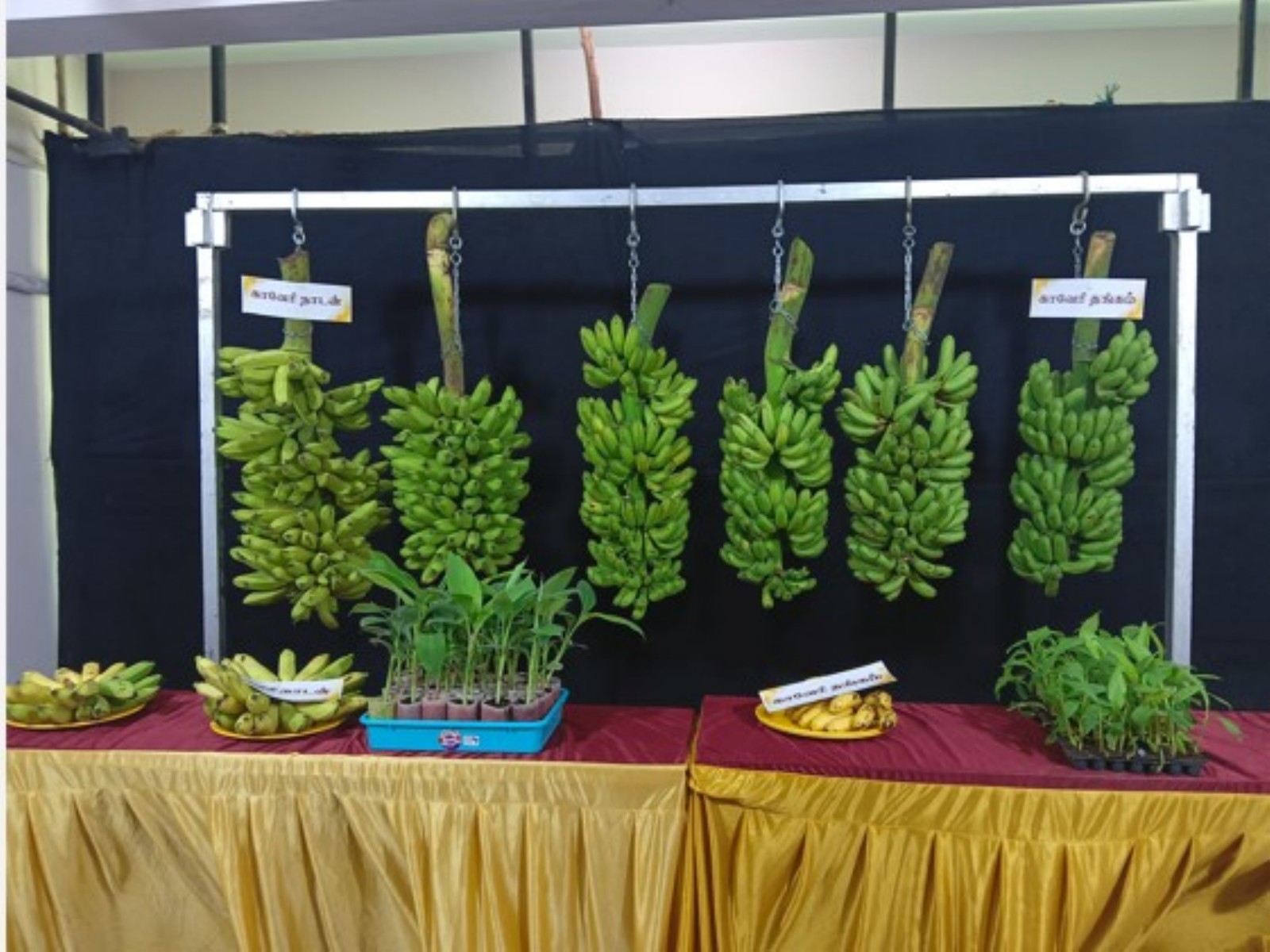
Tiruchirappalli (Tamil Nadu) [India], August 22 (ANI): The ICAR-National Research Centre for Banana (NRCB), Tiruchirappalli, celebrated its 33rd Foundation Day and Farmers’ Day, showcasing its latest research, climate-resilient technologies and value-added banana products.
According to a press release, the NRCB, established on August 21, 1993, has been undertaking research on banana varieties, crop protection, water management, post-harvest technologies and value addition.
On Friday, the celebrations were held at the NRCB premises under the leadership of Director Selvarajan. More than 50 exhibition stalls were set up, showcasing improved banana varieties, modern cultivation practices, fertilisers, value-added products, export procedures and technologies for protecting crops from pests and diseases.
Two new banana varieties, Cauvery Thangam and Cauvery Nadan, were launched during the programme, the press release added.
According to NRCB Director Selvarajan, Cauvery Thangam is rich in provitamin A and contains around 1,000 micrograms of Vitamin A. Consuming around five fruits of the variety can provide the required amount of Vitamin A, making it particularly beneficial for addressing Vitamin A deficiency among children. The variety can remain fresh for up to eight days. Around 10,000 tissue-culture plants of Cauvery Thangam have already been distributed to farmers across Tamil Nadu.
Cauvery Nadan, meanwhile, is a high-yielding variety capable of producing nearly twice the yield of the existing Nadan variety, the Director said.
The press release noted that the NRCB has also developed Kaveri Poovan, another high-yielding variety, and has produced and supplied more than one lakh tissue-culture plants to farmers.
Scientists at the centre advised farmers to adopt climate-resilient banana varieties and modern technologies to address challenges posed by changing weather conditions, water scarcity and crop diseases. They recommended sensor-based and precision irrigation systems, which can help save around 25-30% of irrigation water.
Mulching was also suggested to reduce evaporation, while removal of old leaves was recommended to minimise unnecessary water loss.
The centre is also undertaking research on Fusarium wilt, genome editing and precision agriculture. An IoT-based precision irrigation system developed by the NRCB has helped reduce irrigation water consumption by around 25-30%.
Speaking about banana exports, Selvarajan said India currently exports around one million tonnes of bananas, with export revenue increasing substantially from around $54 million seven years ago to $378 million currently.
He said there are currently no direct banana exports from Tiruchirappalli. However, steps are being taken to facilitate the export of Nendran bananas from the district. Training programmes will be organised for farmers on export-oriented varieties, quality standards and export procedures, with arrangements being coordinated through the Tiruchirappalli District Collector.
The NRCB also highlighted its efforts in value addition, with more than 60 banana-based value-added products developed to create additional income opportunities for farmers and entrepreneurs.
The press release further stated that the Farmers’ Day programme included technical sessions, farmer-oriented training programmes and discussions on Farmer Producer Organisations. Scientists interacted with farmers and provided guidance on crop management, climate-related challenges, water conservation, pest and disease management and modern cultivation techniques.
A large number of banana farmers, scientists, entrepreneurs, officials and members of the public participated in the celebrations, the press release added.
The NRCB said it would continue to focus on research, technology transfer and capacity building to improve banana productivity, promote climate-resilient cultivation, strengthen value addition and enhance farmers’ income. (ANI)
Related reading