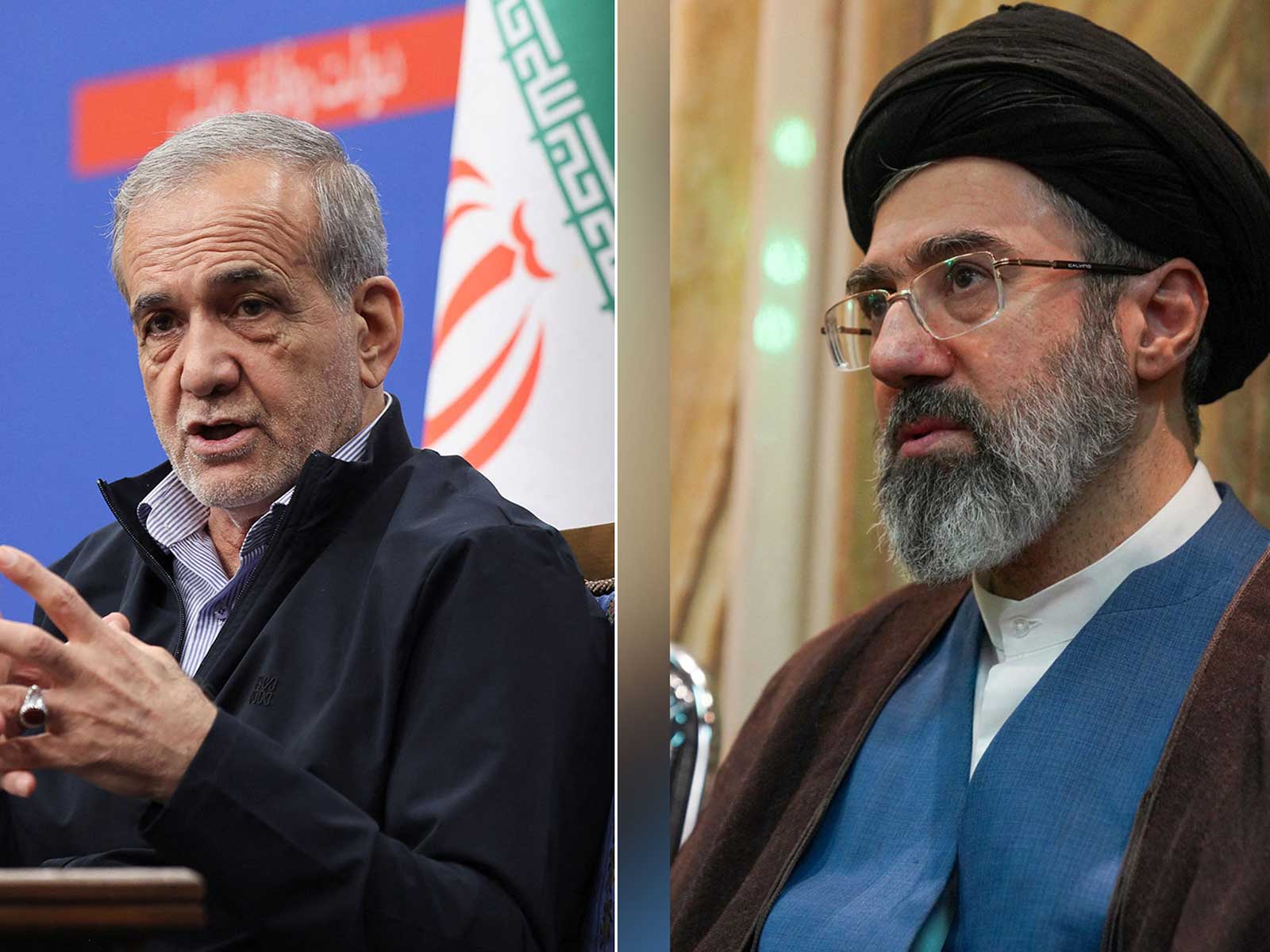
Tehran [Iran], August 10 (ANI): Iranian President Masoud Pezeshkian has stated that Supreme Leader Mojtaba Khamenei is “completely healthy”, dismissing speculations regarding his physical condition, according to a report by the ISNA news agency.
“Someone who can sit and discuss for seven to eight hours cannot have any health problems,” the President said, noting that he had held a “very good” meeting with Khamenei.
This high-level interaction took place amid persistent reports concerning Mojtaba Khamenei’s health. Earlier on Sunday, an undated video was released by Iran’s semi-official Mehr News Agency depicting Mojtaba Khamenei appearing in good health. The video was published following claims in Israeli media that the Supreme Leader was in critical condition and had been admitted to a hospital.
On Friday, Israeli media outlets reported that Khamenei was in an “extremely critical condition”. Citing sources inside Iran, Channel 14, along with The Jerusalem Post, which cited IranWire and sources close to Pezeshkian’s administration, reported that concerns regarding Khamenei’s health were circulating among Iran’s leadership.
The meeting also coincided with Pezeshkian entering his third year in office. He was elected President on July 6, 2024, following his victory in the July 5 election, before receiving formal endorsement from Ayatollah Ali Khamenei on July 28 and being sworn in on July 30. Pezeshkian’s election followed the death of former President Ebrahim Raisi in a helicopter crash.
Mojtaba Khamenei assumed the position of Supreme Leader after his father, Ayatollah Ali Khamenei, was killed in joint US-Israeli military strikes on February 28. Since assuming the role, Mojtaba Khamenei has not made any public appearances, communicating exclusively through written statements.
Contextualising these health clarifications, Iran simultaneously carried out a sudden reshuffle at the top of its political and national-security establishment. Supreme Leader Mojtaba Khamenei moved former Supreme National Security Council (SNSC) Secretary Mohammad Bagher Zolghadr into the role of his political adviser, while appointing veteran Islamic Revolutionary Guard Corps (IRGC) commander Mohsen Rezaei as his representative on the powerful security council.
In a series of posts on X on Sunday, Khamenei announced the appointments, saying, “In consideration of your valuable experience, I hereby appoint you to be my Political Advisor.” Addressing Zolghadr, he added, “I hope that in carrying out this responsibility and in advancing the ideals of the Islamic Revolution, you will be successful and your actions will be accepted under the auspices of the attention of our Master, Imam Mahdi (aj).”
Announcing Rezaei’s appointment, Khamenei said, “Considering your valuable experience, I am hereby appointing you, who were one of the first commanders in the triumphant 8-Year Sacred Defense, to be my representative in the Supreme National Security Council.” Khamenei also expressed appreciation for Zolghadr’s work, saying, “Meanwhile, I would like to appreciate the round-the-clock efforts of our dear brother, Dr. Mohammad Baqer Zolghadr.”
These high-level security moves come just days after Iran issued sweeping conditions for reopening the Strait of Hormuz and as Tehran and Washington continue to communicate indirectly through intermediaries, adding a new layer of uncertainty to Iran’s decision-making structure at a particularly sensitive moment as the West Asia crisis continues.
The reshuffle carries major significance because Zolghadr, a former senior IRGC commander, had only taken over as SNSC secretary in March after the killing of Ali Larijani and had emerged as one of the most prominent hardline voices in Tehran’s security establishment. His transfer does not necessarily diminish his influence; instead, his elevation to become a direct political adviser to Khamenei places him closer to the centre of strategic decision-making.
At the same time, the appointment of Rezaei, another veteran of the Revolutionary Guards and a former IRGC commander, as Khamenei’s representative on the SNSC ensures that a highly experienced military figure remains directly embedded in the country’s top security deliberations. The result is a reshaped leadership architecture in which Zolghadr moves from the formal security machinery into Khamenei’s political inner circle, while Rezaei assumes the institutional security role.
Zolghadr is no ordinary political bureaucrat. A former IRGC officer with decades of experience in Iran’s military, security and political institutions, his appointment as SNSC secretary in March was widely interpreted as strengthening the influence of the Revolutionary Guards over Iran’s strategic decision-making, with reports earlier this year noting his arguments that the IRGC should exercise greater influence over Iranian politics.
Moving closer to the Supreme Leader himself rather than departing the security apparatus has prompted speculation that the reshuffle represents an attempt to concentrate strategic political and security decision-making around a smaller circle of trusted figures with deep IRGC backgrounds. However, the appointment of Rezaei simultaneously creates another powerful IRGC-linked channel into the SNSC, reflecting an effort by Khamenei to balance, coordinate and consolidate competing security and political centres.
The timing of the sequence is striking, as the leadership changes were announced directly after Khamenei’s extensive meeting with Pezeshkian. According to a post by the Supreme Leader on X, the discussions covered the country’s economic and military situation, basic needs of the population, the future of the ongoing conflict, military developments, resource mobilisation and management of spending in domestic currency, foreign currency and energy, alongside economic relations with international partners. (ANI)
Related reading