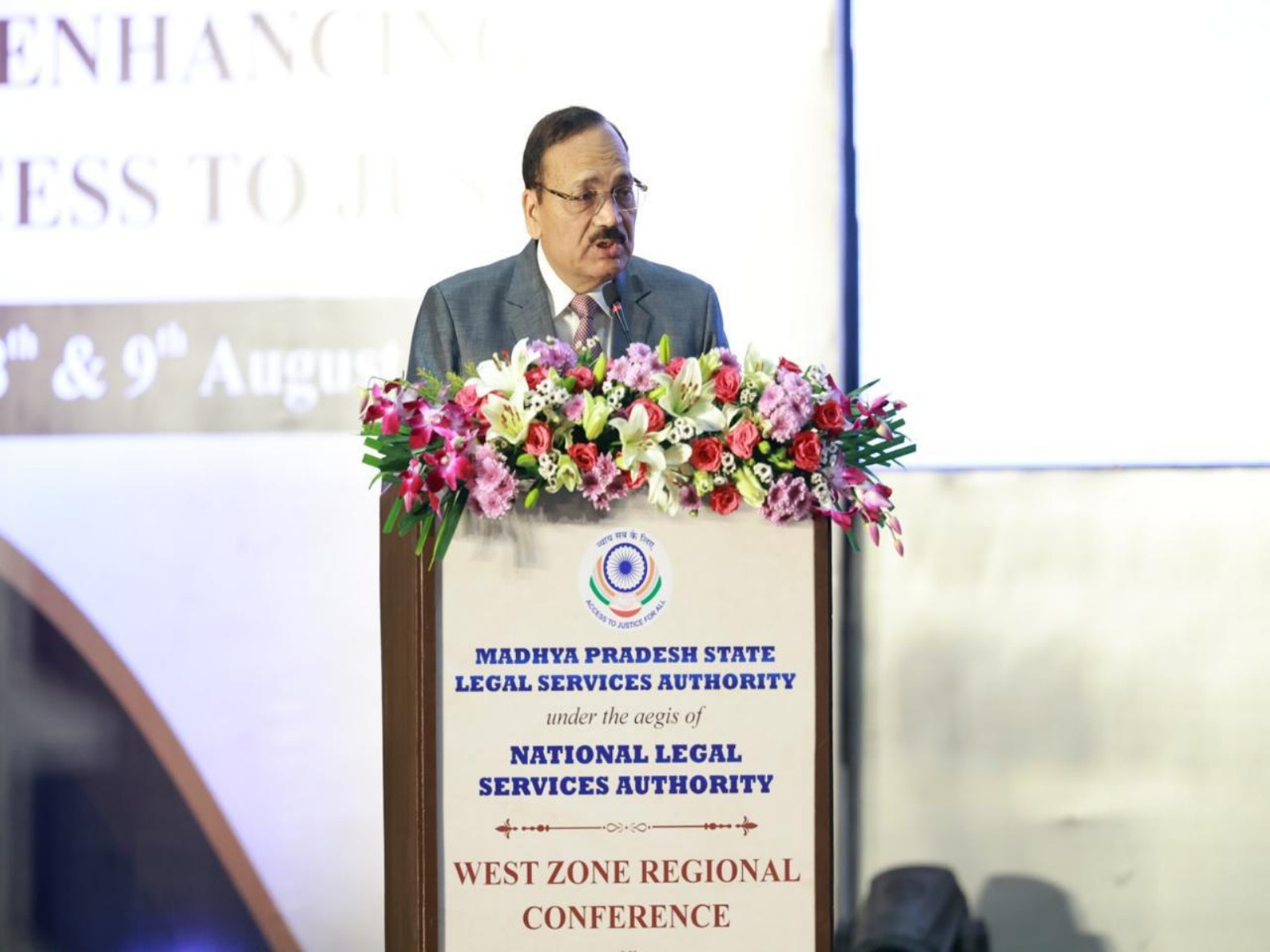
New Delhi [India], August 8 (ANI): Chief Justice of India Surya Kant on Saturday stressed that meaningful access to justice requires legal institutions to reach people who are unable to approach them, saying justice must “travel to the citizen” rather than expecting citizens to travel to the justice system.
Addressing the inaugural session of the West Zone Regional Conference of the National Legal Services Authority (NALSA) in Indore, the CJI said the three pillars of the conference–dialogue, dignity and inclusion–give practical meaning to the constitutional promise of equal justice.
On dialogue, Justice Kant said access to justice cannot be built through laws alone and begins with listening to people’s problems. He said dialogue must operate across the entire legal services framework–from NALSA and State and District Legal Services Authorities to para-legal volunteers who are closest to communities.
He emphasised that a “united voice” does not mean everyone saying the same thing, but working towards the same objective while responding to the needs of the people they serve.
He also highlighted the need for locally tailored legal services, noting that the legal requirements of a tribal family in Madhya Pradesh, a fisherfolk community in Goa, a migrant worker in Gujarat and a woman seeking assistance in Mumbai may be very different.
The CJI said legal awareness should be communicated in familiar language rather than legal jargon and stressed that institutions must also learn from the communities they serve.
Experiences of para-legal volunteers, legal aid lawyers, judicial officers and civil society organisations, CJI said, can help develop practical and lasting solutions.
On dignity, Justice Kant said the experience of justice begins much before a judicial order is delivered. For an ordinary citizen, it starts when they enter a legal aid clinic, court complex or the office of a Taluka Legal Services Authority.
He said many people approaching the legal system for the first time may be unfamiliar with court procedures and hesitant to speak. A patient explanation, respectful conversation and assurance that someone is willing to listen can therefore make a significant difference.
Justice Kant said the Legal Services Authorities Act recognises that certain sections of society require greater institutional support not as charity but as a constitutional entitlement.
He added that every legal aid lawyer who listens patiently, every para-legal volunteer who explains the law simply and every judicial officer who treats litigants with courtesy helps strengthen public confidence in the justice system.
Turning to inclusion, the CJI said access to justice cannot be considered meaningful if even one citizen remains beyond its reach because of distance, poverty, disability, language or lack of awareness.
“The real test of an institution is not how well it serves those who can reach it, but how effectively it reaches those who never can,” he said.
He cited initiatives such as Tele-Law, which he said has enabled more than one crore pre-litigation consultations, the Nyaya Bandhu platform connecting pro bono advocates with people in need, and mobile legal aid clinics reaching remote and tribal areas.
Technology, Justice Kant said, has become an important enabler by reducing distances and expanding access to legal assistance. However, he cautioned that technology is a “bridge, not a destination”, particularly in remote and tribal areas where para-legal volunteers and legal aid lawyers continue to provide the most effective interface with the justice system.
He said inclusion should not merely be measured through schemes or statistics, but should be treated as a continuing approach requiring institutions to identify more villages to reach, vulnerable communities to engage with, languages in which rights need to be explained and barriers that need to be removed.
“Technology has undoubtedly become one of our strongest enablers in this journey. It has shortened distances, expanded outreach and made legal assistance available in places where physical institutions may not always be immediately accessible.”
“At the same time, we must remember that technology is a bridge, not a destination. In many parts of our country, particularly in remote and tribal regions, the most effective interface with the justice system continues to be the para-legal volunteer, the legal aid lawyer or the dedicated volunteer who sits across the table, listens patiently and offers guidance with empathy. No digital platform can replace the trust inspired by a compassionate human presence,” said the CJI.
The CJI said dialogue, dignity and inclusion are inseparable: dialogue ensures that every voice is heard, dignity ensures that every individual is treated with respect, and inclusion ensures that no one is left behind.
Calling on participants to turn the conference’s deliberations into concrete action, Justice Kant said the States in the West Zone should leave with frameworks that can be implemented and with stronger coordination for future collaboration.
He also reminded judicial officers, District Legal Services Authorities, legal-aid counsels and para-legal volunteers that the promise of Article 39A rests equally in their hands, adding that resolutions would matter only if they reached the households for which they were intended. (ANI)
Related reading