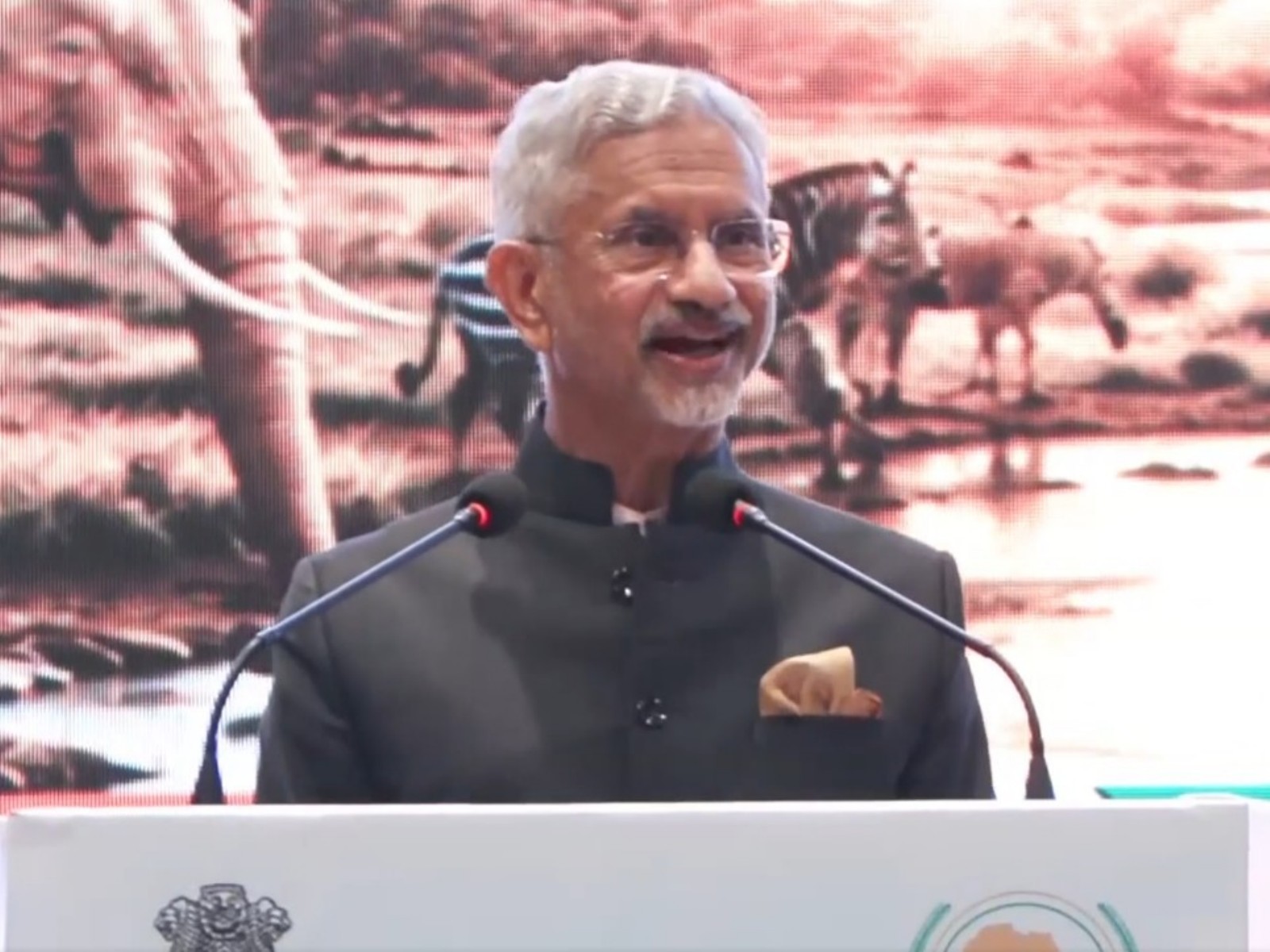
New Delhi [India], August 5 (ANI): External Affairs Minister S Jaishankar on Wednesday emphasised that Africa continues to hold a premier position in India’s foreign policy during his address at the Africa Day celebrations in New Delhi.
Highlighting a decade of intensified cooperation, Jaishankar noted that India’s engagement with the continent is anchored in strategic mutual growth, robust diplomatic expansion, and the shared vision of future development.
Jaishankar drew parallels between India’s growth trajectory under ‘Viksit Bharat 2047’ and Africa’s development blueprint through ‘Agenda 2063’, marking a joint era of rejuvenation.
“In contemporary times, our countries have charted parallel trajectories of resurgence and rejuvenation. This is reflected in our strategies for our future development. In India, that ambition is today expressed in ‘Viksit Bharat 2047’ or Developed India. And for Africa, it is articulated through ‘Agenda 2063’ and respective national development visions,” he said.
The External Affairs Minister also called the inclusion of the African Union as a permanent member of the G20 during India’s presidency a “seminal step” reflecting New Delhi’s commitment to Africa and the wider Global South.
“Friends, the inclusion of the African Union as a permanent member of the G20, to which Ambassador Maliki alluded during India’s presidency, was a seminal step in the direction of India’s enduring commitment to the African continent and indeed to the Global South,” he said.
India’s diplomatic blueprint relies on foundational principles outlined by Prime Minister Narendra Modi in the Ugandan Parliament in 2018, which prioritise demand-driven partnerships, open trade, and local capacity building.
“India’s approach to Africa is guided by the 10 principles outlined by Prime Minister Narendra Modi during his address to the Ugandan Parliament in 2018. These Kampala principles enshrine Africa among the top priorities of India,” he added.
Prime Minister Narendra Modi has laid out a comprehensive vision for India-Africa relations centred on partnership, respect, and shared growth. He said Africa will remain at the forefront of India’s international engagement, with regular and sustained focus.
“Africa will be at the top of our priorities. We will continue to intensify and deepen our engagement with Africa. As we have shown, it will be sustained and regular,” said Jaishankar.
Under this approach, India’s development cooperation will be demand-driven, built around African priorities. It will rely on local talent and aim to build domestic capacity, without placing any future constraints on partner countries.
“Our development partnership will be guided by your priorities. It will be on terms that will be comfortable for you, that will liberate your potential and not constrain your future. We will rely on African talent and skills. We will build as much local capacity and create as many local opportunities as possible,” he added.
On the economic front, PM Modi emphasised the need for open markets. India wants to foster easier trade and create attractive investment conditions, while encouraging Indian industries to deepen their presence across the continent.
“We will keep our markets open and make it easier and more attractive to trade with India. We will support our industry to invest in Africa,” said Jaishankar.
Technology is another key pillar. India plans to leverage its digital strengths to improve public service delivery, education, health, financial inclusion, and digital literacy in Africa. In agriculture too, both sides will collaborate to boost output by tapping into Africa’s vast arable land resources.
“We will harness India’s experience with the digital revolution to support Africa’s development; improve delivery of public services; extend education and health; spread digital literacy; expand financial inclusion; and mainstream the marginalised. This will not just be our partnership to advance the UN Sustainable Development Goals, but also to equip the youth of Africa for their place in the digital age,” said Jaishankar.
The Prime Minister also highlighted climate as a shared priority. India and Africa will work together to address climate challenges, preserve biodiversity, and push for clean energy solutions.
“Africa has 60 per cent of the world’s arable land, but produces just 10 per cent of the global output. We will work with you to improve Africa’s agriculture. Our partnership will address the challenges of climate change. We will work with Africa to ensure a just international climate order; to preserve our biodiversity; and, adopt clean and efficient energy sources,” added Jaishankar.
On security, the focus will be on strengthening joint capabilities to counter extremism, ensuring a safe cyberspace, and supporting UN peacekeeping. Modi further called for an inclusive maritime order based on open and free seas, guided by India’s SAGAR vision of Security and Growth for All in the Region.
“We will strengthen our cooperation and mutual capabilities in combating terrorism and extremism; keeping our cyberspace safe and secure; and, supporting the UN in advancing and keeping peace. We will work with African nations to keep the oceans open and free for the benefit of all nations. The world needs cooperation and not competition in the eastern shores of Africa and the eastern Indian Ocean. That is why India’s vision of Indian Ocean Security is cooperative and inclusive, rooted in security and growth for all in the region,” added Jaishankar.
He stressed that Africa should remain a space for youth aspirations, not a theatre for geopolitical rivalry. Finally, he underlined the need for a reformed, representative, and democratic global order that gives a stronger voice to nearly one-third of humanity living in India and Africa.
“This is especially important to me: as global engagement in Africa increases, we must all work together to ensure that Africa does not once again turn into a theatre of rival ambitions, but becomes a nursery for the aspirations of Africa’s youth,” said Jaishankar.
“Just as India and Africa fought colonial rule together, we will work together for a just, representative and democratic global order that has a voice and a role for one-third of humanity that lives in Africa and India. India’s own quest for reforms in the global institutions is incomplete without an equal place for Africa. That will be a key purpose of our foreign policy,” he added.
Over the past decade, the two regions have witnessed more than 150 high-level visits, with Jaishankar himself visiting African nations over 20 times. India has also expanded its resident diplomatic presence to 46 African countries by opening 17 new missions recently.
“Personally, I’ve had the honour as External Affairs Minister of visiting African nations over 20 times, and I look forward to a few more visits even in the coming months. India has opened up 17 new diplomatic missions in recent years, expanding our resident footprint to 46 African nations,” Jaishankar said.
The inclusion of the African Union as a permanent member of the G20 during India’s presidency was hailed as a seminal milestone for the Global South. (ANI)
Related reading