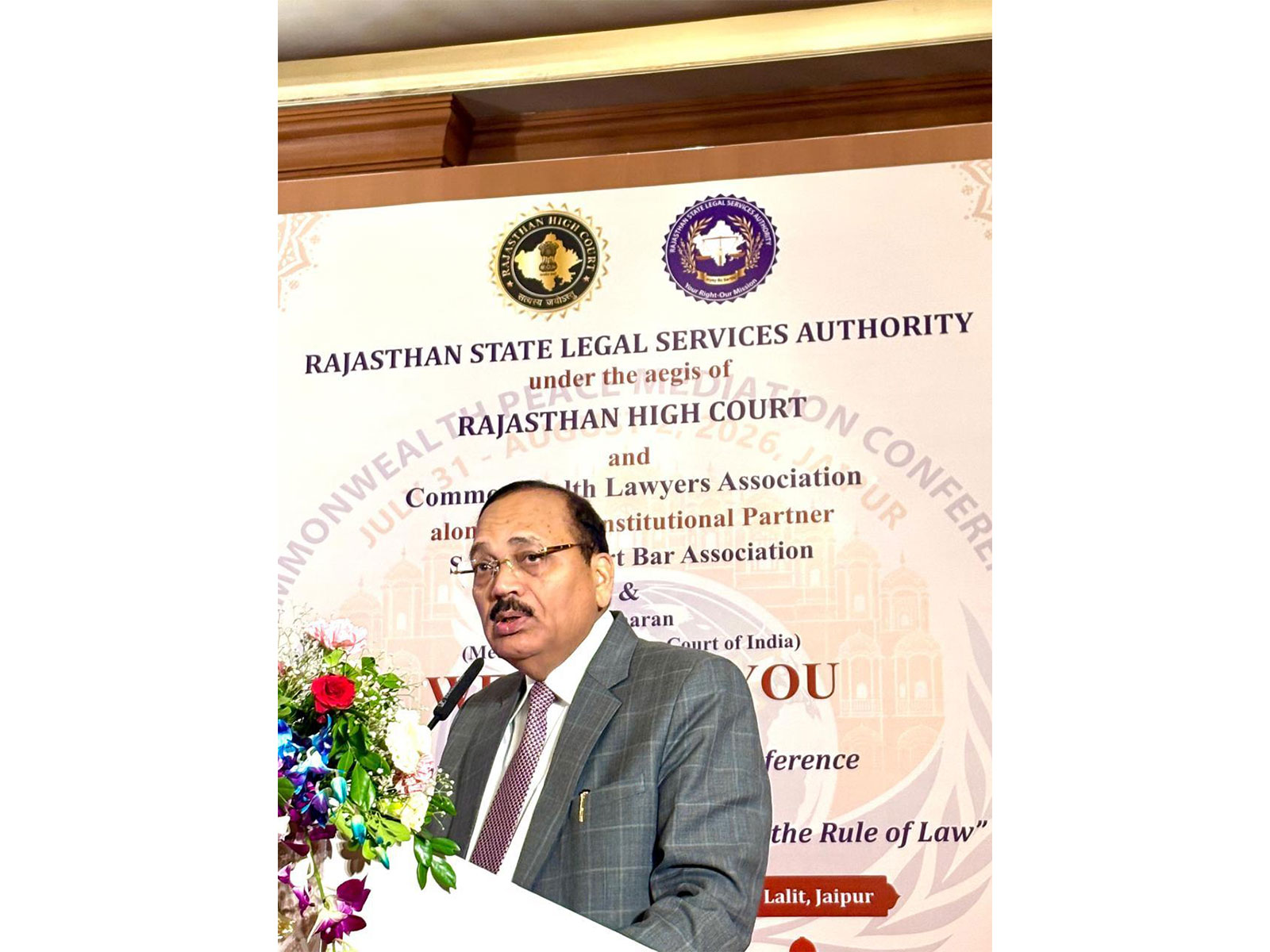
Jaipur (Rajasthan) [India], August 1 (ANI): The Chief Justice of India, Surya Kant, on Saturday said the true purpose of justice is not merely to decide competing legal claims but to understand the underlying interests of disputing parties and help preserve relationships wherever possible.
Delivering the keynote address at the Commonwealth Peace Mediation Conference on the theme “Peace, Mediation and the Rule of Law,” the CJI drew upon the “Orange Quarrel” metaphor to illustrate the distinction between litigation and mediation.
He said litigation adjudicates positions–such as who owns the orange–whereas mediation seeks to uncover the real interests of the parties, often revealing that seemingly irreconcilable disputes can be resolved by understanding what each side truly needs.
Tracing India’s long tradition of conciliatory dispute resolution, the CJI referred to Lord Krishna’s peace mission in the Mahabharata, Kautilya’s Arthashastra, and Mahatma Gandhi’s reflections on resolving disputes outside court, saying mediation has always been part of India’s civilisational ethos long before it acquired statutory recognition.
Highlighting the judiciary’s role in institutionalising mediation, he referred to landmark Supreme Court decisions, saying these decisions strengthened Section 89 of the Code of Civil Procedure, encouraged referral of suitable disputes to mediation, and reinforced confidentiality in mediation proceedings.
The CJI said the Rule of Law does not require every grievance to be adjudicated through a contested trial but requires that every citizen has timely, accessible and dignified access to justice.
He noted that the Mediation Act, 2023 has created a comprehensive statutory framework for voluntary, court-annexed and community mediation, while the Supreme Court’s Mediation and Conciliation Project Committee and mediation centres across High Courts have expanded the country’s mediation infrastructure.
“The Rule of Law does not demand that every grievance be adjudicated; it demands only that every citizen enjoy timely, accessible, and dignified recourse to justice. This judicial persistence has since found legislative and institutional expression. The Mediation Act of 2023 has, for the first time, given our country a comprehensive statutory architecture for voluntary, court-annexed, and community mediation alike,” said the CJI.
Emphasising the expanding scope of mediation, the CJI said it is no longer confined to matrimonial or neighbourhood disputes.
“What was once confined to the courtyard of the family has found its way into the boardroom, and the transition has been a natural one, for the underlying wisdom that preserving a relationship often serves interests better than simply vindicating a position, applies with equal force whether the relationship is between spouses or between shareholders,” the CJI said.
Insurance companies, multinational corporations and businesses increasingly rely on mediation clauses in commercial agreements to preserve long-term relationships, while sectors such as infrastructure and construction could significantly benefit from mediation mechanisms built into contracts from the outset.
The CJI stated this while addressing the gathering at the event organised by Rajasthan State Legal Services Authorities.
He also suggested strengthening local communities and panchayats as accessible forums for mediated justice.
Concluding his address, the CJI said mediation offers structural advantages over litigation and arbitration because it allows parties to craft their own solutions in the language of their own choosing, at a pace and cost proportionate to the dispute.
He praised the organisers of the Commonwealth Peace Mediation Conference for advancing the ideals of peace, mediation and the Rule of Law, saying such forums ensure that India’s longstanding tradition of reconciliation continues to evolve for contemporary needs. (ANI)
Related reading