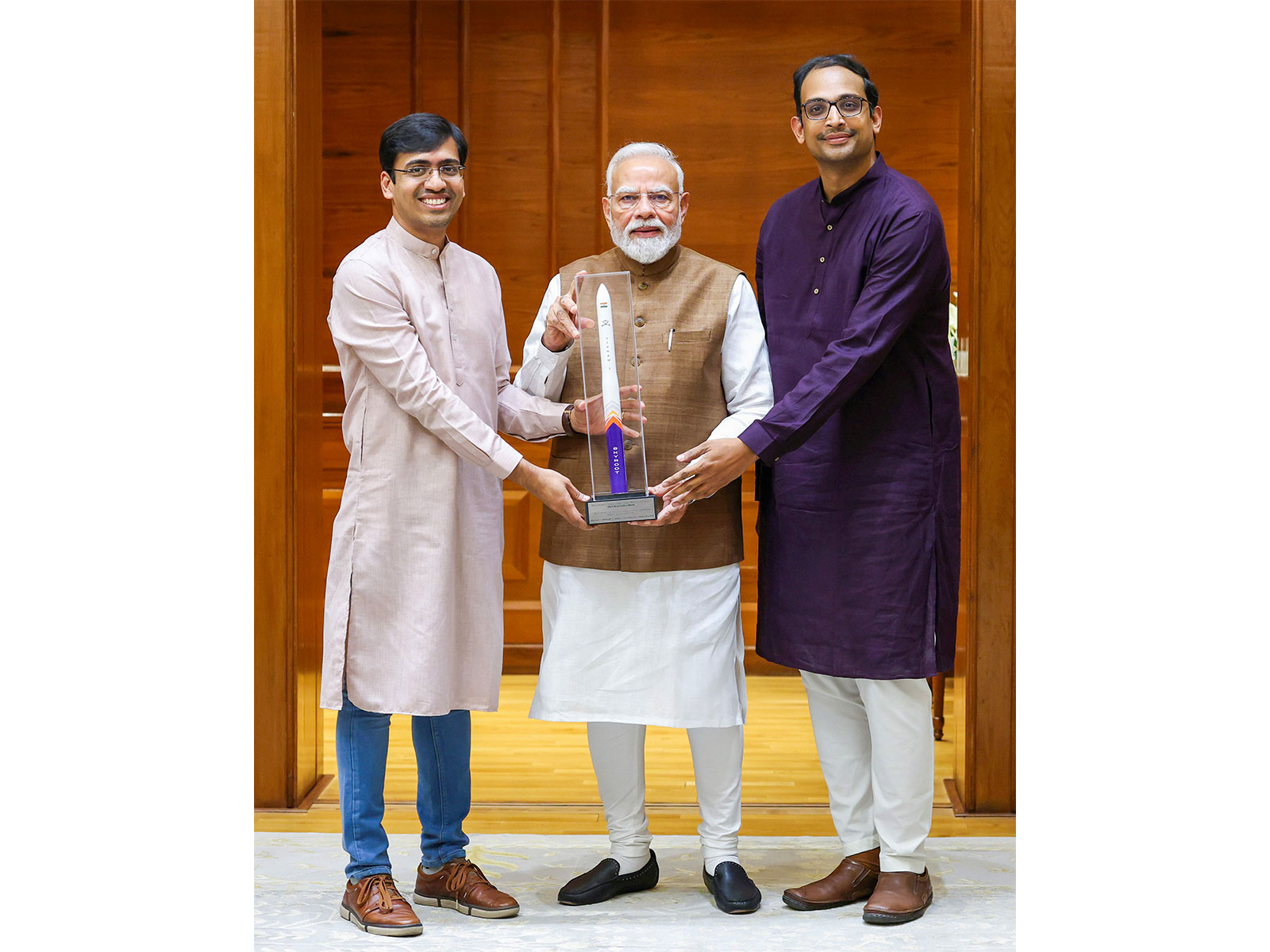
New Delhi [India], July 27 (ANI): Prime Minister Narendra Modi on Monday had a “great interaction” with Skyroot Aerospace founders Pawan Chandana and Naga Bharath Daka and discussed the success of the Vikram-1 mission and the future of India’s private space sector.
In a post on X, Modi said he had a “great interaction” with Chandana and Daka, adding that the “success of Vikram-1 naturally featured prominently” in their discussion.
https://x.com/narendramodi/status/2081756220587913379
“A great interaction with Pawan Chandana and Naga Bharath Daka of Skyroot Aerospace. The success of Vikram-1 naturally featured prominently in our discussion, in addition to many other interesting subjects. Happy to hear about their journey so far and their insights on what lies ahead. Their energy, ambition and positivity reflect the vibrant spirit of our private space ecosystem. Best wishes to the entire Skyroot team,” PM Modi wrote on X.
Skyroot Aerospace also posted about the meeting on X, saying its founders had the privilege of sharing the company’s journey, Vikram-1’s successful mission and its vision for the future of space with PM Modi.
“An honour to meet Hon’ble Prime Minister Shri @narendramodi. Our founders, Pawan Chandana and Naga Bharath Daka, had the privilege of sharing Skyroot’s journey, Vikram-1’s successful mission, and our vision for the future of space,” he wrote on X.
On July 18, Skyroot Aerospace’s Vikram-1 Test Flight-1 successfully reached orbit, marking the maiden flight of India’s first privately developed orbital-class rocket. The rocket completed its final burn and injected its payloads into a nearly 450-km orbit, making India the third country in the world with private orbital launch capability.
The mission, named “Mission Aagaman”, was executed from the Satish Dhawan Space Centre. The 24-metre carbon-composite rocket completed all planned flight stages, including stage separations and the firing of its Orbital Adjustment Module (OAM).
The Orbital Adjustment Module fired its 3D-printed liquid engine for the final push to orbit. The module is designed to start, stop and restart in space. During the flight–Kalam-1200, the solid first stage carried the rocket through the thickest part of the atmosphere before separating cleanly. The payload fairing was then separated, exposing the satellites to space for the first time.
The second stage, Kalam-250, completed its burn and separated, followed by the ignition of Kalam-100, the smallest and highest-flying solid stage of Vikram-1. The solid-propulsion phase concluded with the separation of Stage 3, paving the way for the Orbital Adjustment Module to complete the mission.
The Vikram-1 rocket, powered by three solid-fuel stages and a liquid orbital adjustment module, is designed to deploy payloads up to 350 kg into a 450-km Low Earth Orbit (LEO). The maiden flight carried multiple payloads, including the “Diamond Lotus”, a lab-grown diamond from Bengaluru-based Cosmos Diamonds. (ANI)
Related reading