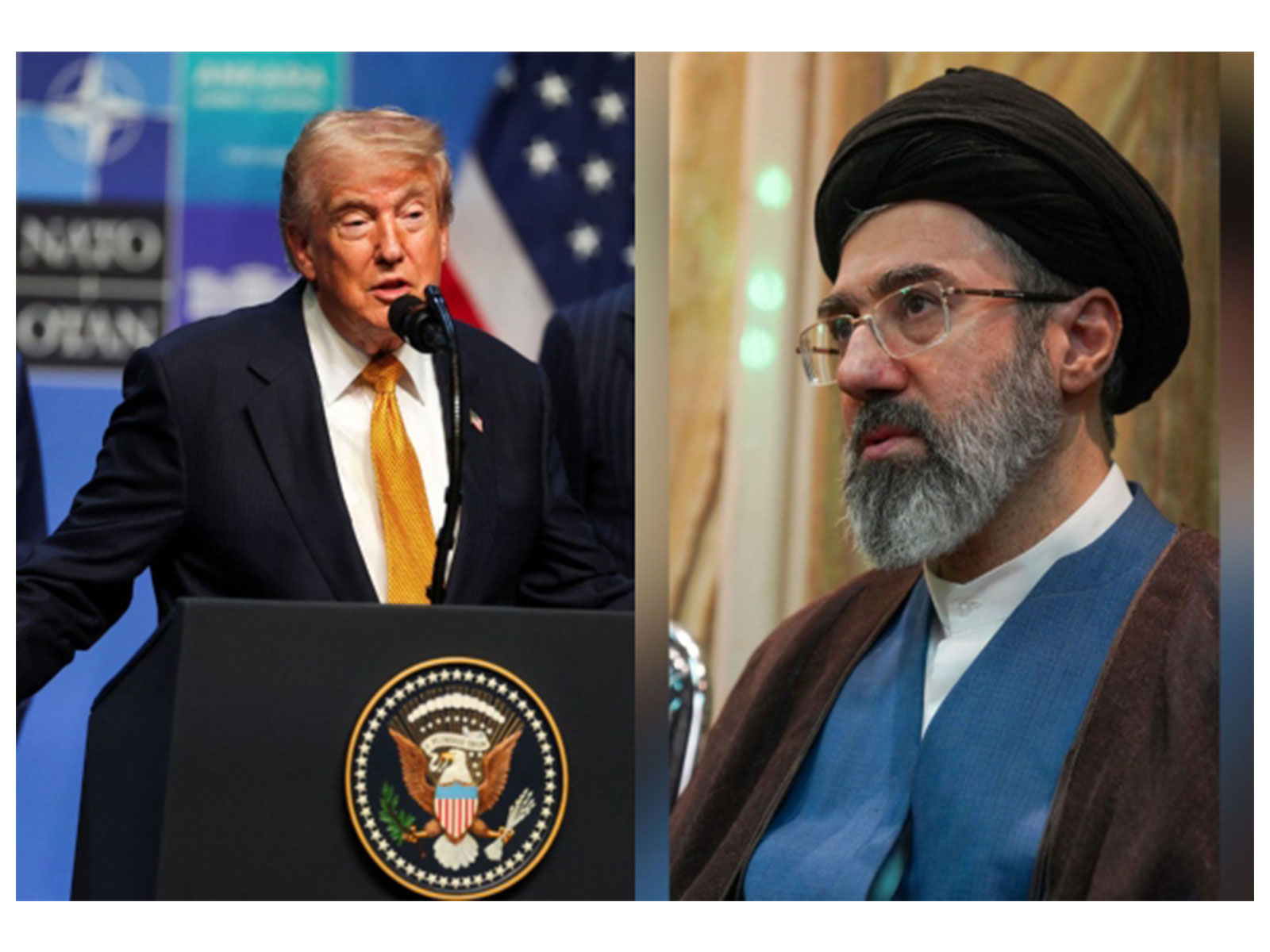
Washington DC [US], July 20 (ANI): US President Donald Trump on Monday doubled down on his administration’s hardline stance in the ongoing conflict against Iran, issuing a public directive to his military leadership.
In a post on Truth Social, the President vowed stern retaliation from the US military to every Iranian attack.
“Every time Iran kills an American soldier, they will pay for that killing many times over! This directive has been passed on to Secretary of War, Pete Hegseth, Chairman of the Joint Chiefs of Staff, Daniel Caine, and every Leader in the Military,” he said.
This escalation follows a dramatic surge in hostilities today as the US conducted a ninth consecutive day of airstrikes against Iranian targets.
Iranian state media detailed multi-city explosions along the southern coastline and inside the northwestern hub of Tabriz, signalling a broader geographical expansion of the military operation.
US President Donald Trump, upon returning to Washington after attending the FIFA World Cup final, stated that the latest round of retaliatory strikes honoured three American service members killed in the theatre of conflict. He further asserted that the operations remain focused on blocking Iran’s path to a nuclear weapon.
Meanwhile, the US military stated that it has disabled one ship and redirected seven in its continuing blockade of the Iranian ports.
In a post on X, the US Central Command wrote, “U.S. service members aboard amphibious assault ship USS Boxer (LHD 4) support flight operations day and night from the Arabian Sea as CENTCOM enforces the naval blockade against Iran. As of July 20, the US military has redirected 7 commercial vessels and disabled 1 to prevent the ships from leaving or entering Iranian ports.”
On the other hand, Iran’s Islamic Revolutionary Guard Corps (IRGC) Navy claimed to have delivered “heavy blows” to US forces through a coordinated three-stage offensive Operation Nasr 2.
According to the official statement posted by Tasnim news agency, IRGC forces reported the destruction of storage and maintenance hangars for US drone units at Al Sakhir Airport in Bahrain, in the first stage.
The second stage targeted preparation hangars for TF-59 vessels in Salman Port, Bahrain, resulting in their destruction and significant damage to the vessels. In the final stage of this wave, the IRGC claimed to have completely annihilated hangars at the Arifjan Base in Kuwait that were used for the deployment, support, and equipping of U.S. Navy SEAL special forces.
In response to President Trump’s recent claims that Iran’s supply of missiles and drones is nearly exhausted, the IRGC Public Relations office dismissed the President as “foolish” and “ignorant.” The statement warned that should the war continue for years, Iranian drones and missiles would “rain down on American criminals until the very last day.”
“The foolish U.S. President, who has repeatedly confessed to his ignorance and folly regarding the state of the world, and who says he assassinated our martyr Imam without knowledge of the depth of his influence among the peoples of the world and the profound love and affection of the Iranian people and other nations for him, and who says he waged war in this region unaware of the importance of the Strait of Hormuz to the global economy, once again exposed his folly and ignorance last night and stated that Iran has only a few missiles and drones left, which are running out,” the IRGC statement read.
“The murderous U.S. President should know that if this war lasts for several years, by the leave of Almighty God, our missiles and drones will rain down on American criminals until the very last day,” it added.
Meanwhile, the conflict has increasingly impacted regional stability and civilian infrastructure.
In Bahrain, the Interior Ministry issued urgent alerts for residents to seek shelter as warning sirens sounded repeatedly throughout the day.
This comes after IRGC claimed responsibility for “simultaneous” missile and drone strikes against US military facilities in Bahrain and Kuwait, asserting that these operations delivered “heavy blows” to American forces.
According to the statement carried by IRNA news agency, the IRGC Navy targeted “drone maintenance and repair hangars” at Bahrain’s Al-Sakhir Air Base, claiming the facilities were left in a state of “destruction”.
The IRGC also reported hitting “preparation hangars for Task Force 59 (TF59) vessels at Salman Port in Bahrain,” which it stated resulted in “destruction and heavy damage” to the structures and the vessels themselves.
Meanwhile, in a statement carried by the Tasnim news agency, the IRGC asserted that the cross-border operation successfully obliterated 20 hangars housing US forces at Jordan’s al-Azraq air base, resulting in the elimination of dozens of American troops. Furthermore, the IRGC alleged that its arsenal of ballistic missiles directly struck US C-17 transport aircraft and P-8 surveillance aircraft stationed at Aqaba airport, inflicting severe structural devastation.
However, official figures released by Washington present a vastly different casualty count, maintaining that 17 American service members have been killed since the conflict began.
In Jordan, the satellite images shared by Tasnim news agency underscored the intensity of the exchange, revealing destroyed shelters, damaged aircraft hangars, and significant impact points within areas designated for troop accommodation.
In Kuwait, the IRGC claimed it targeted facilities utilised to station and equip US special naval commando forces at Camp Arifjan, stating that the strikes “targeted and set ablaze” the site, leading to it being “destroyed completely.”
The violence has also reached deeper into Iranian territory; the Fars news agency reported that an Iranian military officer, Mahdad Pashae, was killed during a US strike in the northwestern city of Tabriz.
Additionally, the deputy governor of Iran’s Fars province confirmed a US aerial attack on an area in Shiraz, though officials claimed there were no casualties and the situation remained under control, according to Al Jazeera.
Notably, a vessel caught fire in the strategic Strait of Hormuz following a missile strike, prompting an immediate evacuation of the mariners on board.
The United Kingdom Maritime Trade Operations (UKMTO) confirmed the incident, stating that “the crew safely abandoned the vessel and have been recovered by a tug boat”.
According to the maritime security watchdog, the assault took place approximately 15 km (8 nautical miles) northwest of Kumzar, Oman.
Earlier in the day, Iranian President Masoud Pezeshkian said that Tehran is engaged in a “full-scale war” with the United States, asserting that the conflict extends beyond military strikes and warning that the country must accept the consequences of its resistance while continuing to defend its national interests.
Addressing a meeting of Iran’s Supreme Judicial Council, Pezeshkian said, “The reality is that today the Islamic Republic of Iran is engaged in a full-scale war. Today’s war is not simply a war of missiles; the enemy has come to the conclusion that it cannot force the Iranian nation to surrender through military attacks.”
Earlier, Iranian Foreign Ministry spokesman Esmaeil Baghaei revealed that Washington has recently transmitted messages to Tehran via third-party intermediaries, even as heavy fighting persists between the two factions.
Addressing a news conference in Tehran, the spokesperson confirmed the backchannel communications but refrained from disclosing specifics regarding the diplomatic notes.
“We have been informed by mediators. We have received messages, without going into details, but the main point is that the diplomatic apparatus has been active in recent days and ideas have been conveyed to us by certain mediators,” the Foreign Ministry spokesman said.
Baghaei firmly pinned the blame for the current military flare-up on Washington, asserting that the responsibility for the recent escalation lies with the US.
On the other hand, United States Secretary of State Marco Rubio indicated that Washington is receiving feelers through diverse channels regarding Tehran’s willingness to hold talks, against the backdrop of widening fissures within the Iranian leadership.
Speaking to CNN, Rubio remarked, “We are receiving signals through multiple channels of Iran’s desire to negotiate, but there is a growing split within the regime.”
Rubio maintained that defensive military actions and diplomatic tracks could proceed concurrently, reiterating that the US continues to target a negotiated resolution.
“What I will say is that the United States always remains open to a diplomatic solution. We’ve tried multiple times with Iran, and we’ll continue to try,” he said.
His assertions come against the backdrop of persistent military confrontations between the US and Iran. Washington has maintained that its targeted strikes are designed to degrade Tehran’s military infrastructure, particularly assets tied to maritime assaults on commercial vessels transiting the strategic Strait of Hormuz. (ANI)
Related reading