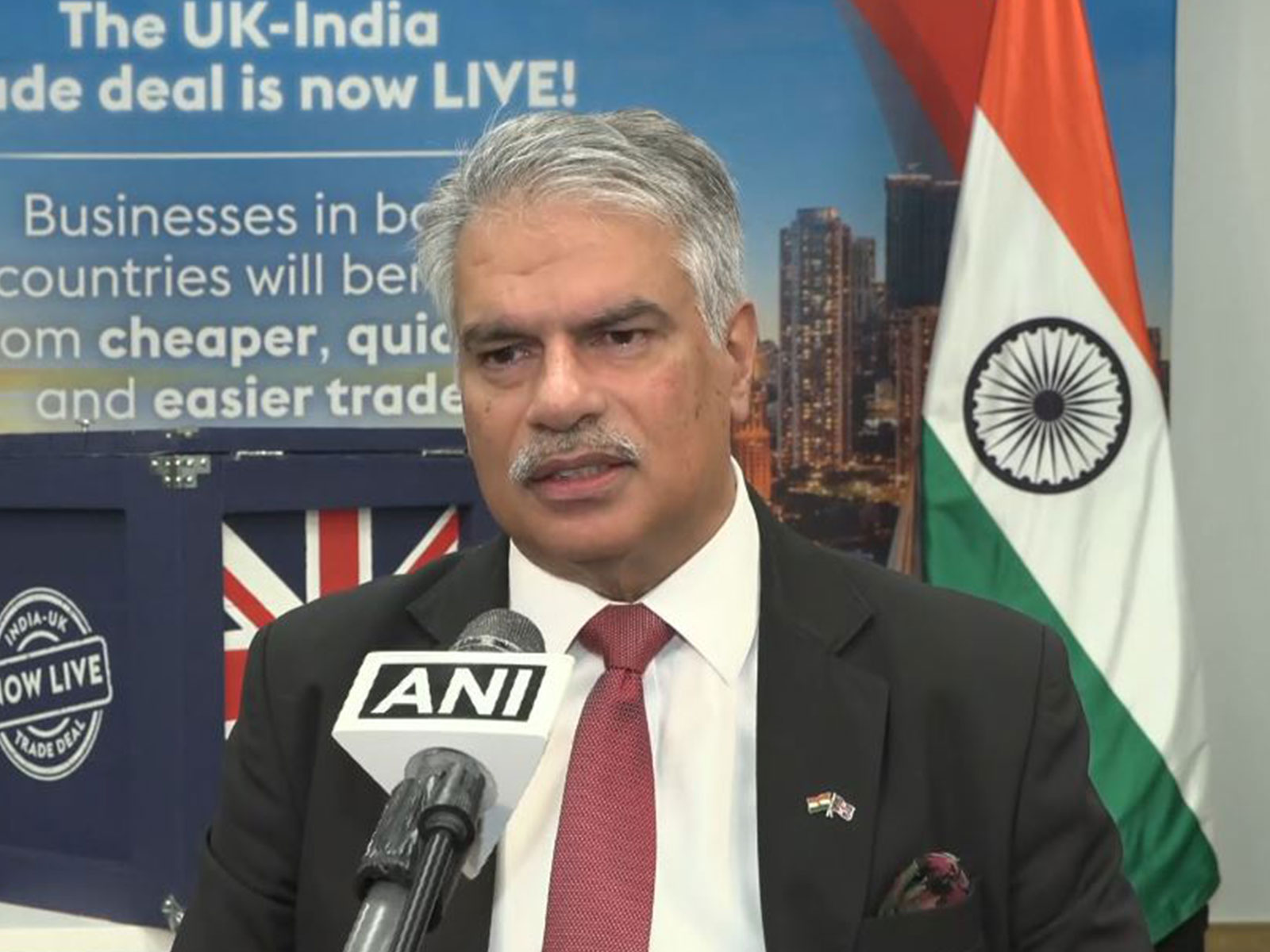
Mumbai (Maharashtra) [India], July 15 (ANI): With the much-anticipated India-UK Free Trade Agreement (FTA) now in effect, the United Kingdom’s Chief negotiator for the deal, Harjinder Kang, said on Wednesday that the pact was designed to be future-proof, with both the British and Indian sides showing political intent in committing towards the deal.
In an exclusive interview with ANI, Kang recalled the negotiations held to reach the India-UK FTA and said that despite India being a tough negotiator, both sides displayed political intent, which helped towards sealing the deal.
“Every trade deal is tough to negotiate, and negotiating with a country called India is even tougher. There was a lot of political intent here. Both sides actually wanted to do a deal. If you don’t have that, it’s much more difficult,” he told ANI.
He noted that the negotiations continued despite a change of government in the UK.
“We remember we had a change of government halfway through this,” he said, adding that the negotiations started under the Conservative Party and ended under the Labour Party, which became the ruling government at the time.
“So it gave us great confidence as officials that, no matter the government of the day, both sides supported this deal, and that’s what made it happen in the end of the day,” he said.
He further underlined, “On the Indian side, there was continuity throughout. The Indian team was very tough. The UK team were very tough. So that’s why it took five years. You have to make this future-proof. It’s not just for a year or two. It’s for decades to come.”
When asked if the FTA would help both countries navigate the geopolitical and global uncertainties, Kang said that the pact provides for a stable framework for strengthening economic cooperation between the two partner countries.
“This was never designed to fix the problems of the world. This was designed to actually help the two economies work together. This should help both countries actually do business with each other on a bilateral basis. There are going to be turbulent times. Right now, it will certainly help India and the UK; we have two markets which are now a bit more stable, and I know in terms of our relationship, we can build on that going forward,” he said.
Earlier today, British High Commissioner to India Lindy Cameron described the landmark India-UK Free Trade Agreement (FTA) that came into effect on Wednesday as “a historic moment” that will unlock new opportunities for businesses, workers and consumers in both countries while significantly deepening the bilateral economic partnership.
“The UK-India FTA has come into effect today. It is a really exciting day and a historic moment for the modern UK-India partnership,” Cameron said, adding that the agreement is expected to increase bilateral trade by more than GBP 25 billion annually in the long run while boosting the combined GDP of both countries by nearly GBP 5 billion
Calling the agreement “the new gold standard of trade deals,” Cameron said it is the most ambitious free trade agreement either country has implemented to date, covering 30 chapters on goods, services, procurement and other areas. She added that around 99 per cent of Indian goods entering the UK and approximately 90 per cent of tariff lines for UK exports to India would now benefit from duty-free or reduced-tariff access.
Infrastructure, clean energy, financial services, manufacturing, creative industries and consumer goods are among the sectors expected to gain significantly as the landmark India-UK Free Trade Agreement (FTA) came into effect on Wednesday, reducing tariffs, expanding market access and easing business mobility between the two countries, Cameron said.
She said the enthusiasm surrounding the agreement had been evident among companies across the United Kingdom, ranging from large corporations to micro, small and medium enterprises (MSMEs). During a UK-wide roadshow held across six cities, British businesses expressed optimism about expanding into India as the deal lowers trade barriers and creates fresh export opportunities.
Cameron cited examples of companies that now see India as a major growth market, including a Manchester-based manufacturer of dyes used in plastic bottles and a copper products company expecting reduced tariffs to make its products more competitive in India.
“This deal has a net positive effect on both our economies and on wages, which has remained a priority for both governments,” she said.
Highlighting the complementary nature of the two economies, Cameron said the agreement combines Britain’s strengths in design, sustainability and innovation with India’s scale, ambition and rapid infrastructure development. She noted that improved business mobility under the FTA will make it easier for engineers, consultants and professional services firms from both countries to collaborate on major projects.
The agreement also opens government procurement markets, allowing UK companies easier access to India’s central procurement market, valued at around GBP 38 billion annually, while guaranteeing Indian firms access to UK procurement opportunities. She said this would particularly benefit urban infrastructure projects, where lower tariffs on specialist equipment, engineering solutions and innovative technologies would make British products more competitive.
According to Cameron, the agreement provides greater certainty for financial services firms, including banks, insurers and fintech companies, while strengthening collaboration in creative industries by protecting intellectual property rights for Indian animation studios and UK game developers.
She added that clean energy would be another major beneficiary, with 98 per cent of environmental and green goods being liberalised. This would support India’s energy transition while boosting UK exports of turbines, generators and renewable energy components. (ANI)
Related reading