
PNN
New Delhi [India], July 9: For 17 years, ExamOnline has answered a fairly narrow question – how do you deliver a secure, tamper-proof exam to someone sitting at a laptop, anywhere in the world? The Mumbai-headquartered platform has answered it well enough to power millions of assessments for 250-plus enterprise clients across 35-plus countries.
Now it’s asking a different question: what happens when the thing you’re testing can’t be captured by a multiple-choice screen at all?
Where the Browser Window Runs Out of Road
A written exam is very good at confirming that a candidate knows something. It is far less convincing when the goal is to confirm that a candidate can do something – insert a cannula, isolate a fault in an HVAC unit, de-escalate an angry customer, work safely around live electrical equipment. For fields like healthcare, manufacturing, technical trades, and hazardous-environment training, competency lives in the hands and the decision-making, not in a bubble sheet.
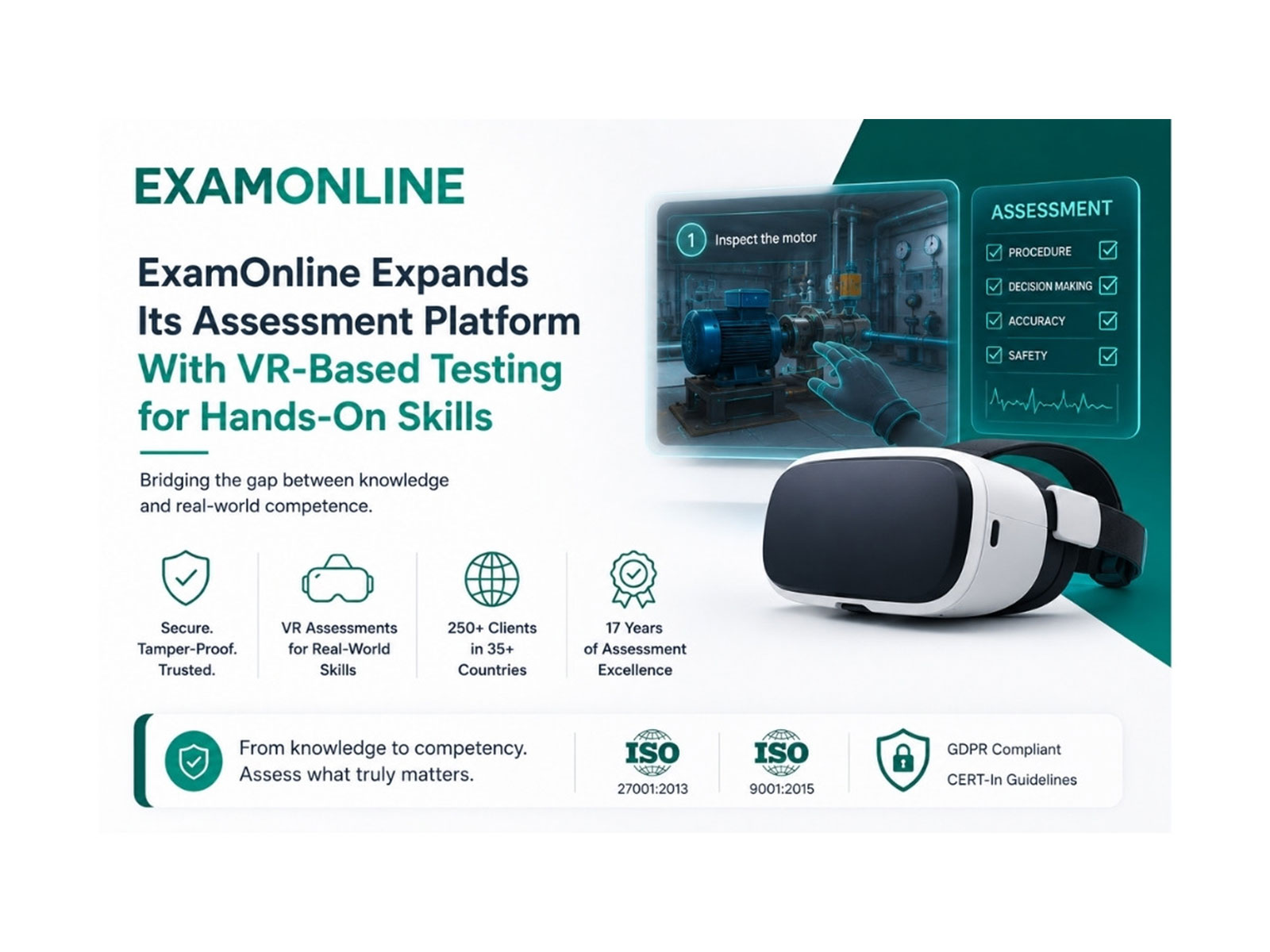
That’s the gap ExamOnline’s new VR Assessment Solution is aimed at – and it’s worth being precise about the scope. This isn’t a bet that every exam is moving into a headset. Theory papers, aptitude tests, and knowledge-based certifications will keep running exactly as they do today, on ExamOnline’s existing AI-proctored, browser-based infrastructure. VR is being layered in specifically for the practical and vocational side of assessment – the portion of testing where “explain the procedure” has always been a weaker proxy for “perform the procedure.”
Inside the simulation, candidates work through scenarios built to mirror real operational conditions, while evaluators observe decision-making, sequencing, and procedural accuracy in an environment that’s controlled, repeatable, and fully auditable. Crucially, the same integrity backbone that secures ExamOnline’s conventional exams – identity verification, behavioural monitoring, session documentation – travels with the candidate into VR, so an immersive assessment isn’t a compliance downgrade from a traditional one.
For a nursing board, that means evaluating clinical judgment inside a simulated ward instead of relying purely on written case studies. For a technical certification body, it means testing equipment troubleshooting without needing every candidate to physically access a lab.
The Market ExamOnline Is Stepping Into
ExamOnline isn’t early to VR-based learning and assessment – it’s stepping into a category that’s already moving fast. A few numbers worth sitting with:
* The global VR-in-education market was valued at roughly $31-37 billion in 2025-26 and is projected to climb toward $83-95 billion by the early 2030s, growing at a compound annual rate north of 16-20%.
* VR-based training has been shown to improve learning effectiveness by as much as 76% over traditional methods, with some studies pointing to retention rates of up to 80% a year after training – well above the 20-30% typical of classroom-only instruction.
* Enterprise and vocational use cases – not gaming – are increasingly where the growth is: by 2030, enterprise users are expected to account for more than 60% of total VR revenue, and application areas like medical training and vocational/technical skills are now explicitly called out as distinct segments by market analysts.
* Cost curves are bending in the industry’s favor too – standalone headset prices have dropped sharply in recent years, and VR training is now estimated to reach cost parity with classroom delivery at scale, becoming meaningfully cheaper once deployments cross a few thousand learners.
In other words, the institutional appetite for immersive, skills-based assessment isn’t a hypothesis – it’s already showing up in enterprise training budgets, and assessment is the natural next layer on top of it. That’s the wave ExamOnline is positioning its 17 years of proctoring and integrity infrastructure to ride.
Built the Same Way It Always Has Been
What hasn’t changed is ExamOnline’s operating discipline: no external funding, no aggressive market-entry spend, and no feature shipped without verified institutional demand behind it. The company holds ISO 27001 and ISO 9001 certifications, is GDPR-compliant, and operates under CERT-In guidelines – and that compliance backbone extends by design into the VR product line, alongside the remote, AI-proctored hiring assessments the platform also runs for enterprises managing high-volume campus recruitment.
“Assessment is not a category that stays static, and neither should the platforms that serve it,” said Maneesh Singh, CEO of ExamOnline. “We built our reputation on solving the integrity problem for traditional online examinations. VR assessment is the same problem, applied to a format where the stakes have changed but the need hasn’t – institutions still need to trust the result. Institutions don’t need a different vendor for every new assessment modality. They need one platform that’s already proven it can be trusted with the ones that matter most.”
As global EdTech consolidates and institutions grow more selective about which vendors they’ll trust with mission-critical evaluation, ExamOnline’s bet is a simple one: the platforms that win this next phase won’t be the ones with the longest feature list. They’ll be the ones that have already spent nearly two decades proving they don’t fail when it counts.
(ADVERTORIAL DISCLAIMER: The above press release has been provided by PNN. ANI will not be responsible in any way for the content of the same.)
Related reading