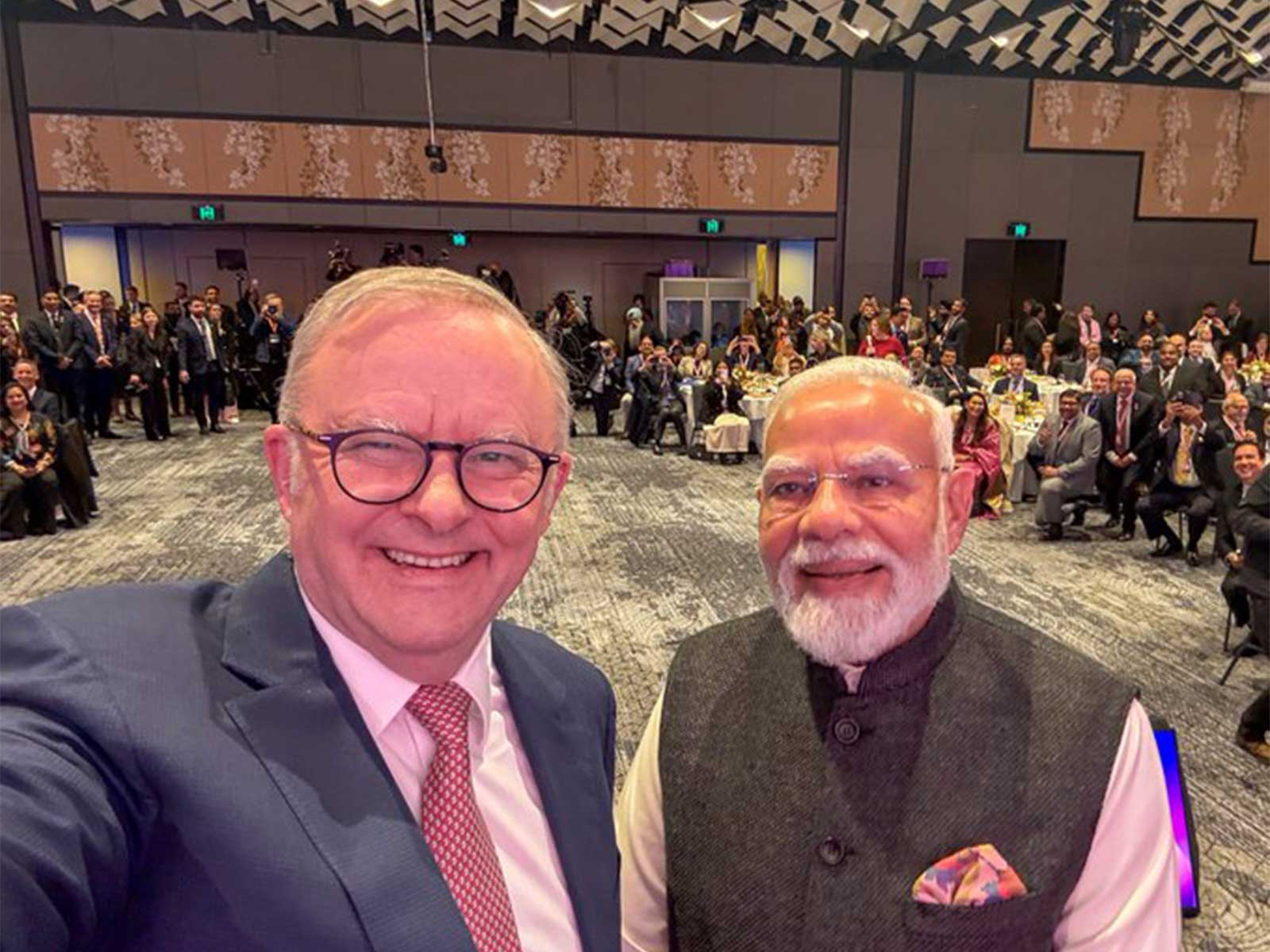
Melbourne [Australia], July 9 (ANI): Capturing a moment of warm camaraderie that transcended formal diplomacy, Prime Minister Narendra Modi and his Australian counterpart, Anthony Albanese, shared a historic selfie following their participation in the India-Australia CEO Forum and Economic Roadmap Business Reception. The candid moment perfectly encapsulated the spirit of the high-profile economic and strategic engagement between the two nations.
This visual highlight capped off an intensive day of bilateral diplomacy where, highlighting the escalating economic synergy between India and Australia, Prime Minister Narendra Modi characterised the two nations as “natural and trusted partners” amid global uncertainty. He urged enterprises from both sides to intensify cooperation across key sectors, including clean energy, infrastructure, artificial intelligence, and education.
Earlier, welcoming corporate leaders from both countries at the Economic Roadmap Business Reception during the India-Australia CEO Forum, PM Modi noted that their participation mirrored the “shared confidence and aspirations” of India and Australia, setting the stage for his key address.
Addressing the forum, the Prime Minister stated, “Today, the world is going through a period of uncertainty, supply chain disruptions, and an energy crisis. At such a time, it is both natural and necessary for India and Australia to move forward as natural and trusted partners. Over the past few years, we have built a strong framework for future cooperation by combining the capabilities of both countries.”
As a foundational success of this partnership, PM Modi observed that the India-Australia Economic Cooperation and Trade Agreement (ECTA), finalised in record time in 2022, has substantially fortified bilateral commercial ties, unlocking novel avenues for businesses in both nations.
“Since its implementation, exports from India to Australia have doubled, and businesses in both countries have benefited from new market access; however, we have not stopped there — we are now moving towards a Comprehensive Economic Cooperation Agreement,” he remarked.
Expanding on this momentum, he further added, “Through these efforts, the governments of both nations have prepared a new runway, and the aircraft of investment and innovation is now ready to take off. You all have to take this to new heights.”
To fuel this next phase of growth, the Prime Minister turned the spotlight on the clean energy landscape, asserting that India is swiftly developing a robust manufacturing framework for hydroelectric initiatives, green hydrogen, solar modules, and wind energy infrastructure.
Interacting directly with representatives of clean energy firms at the forum, he stated, “We are building a manufacturing ecosystem in India for hydro projects, green hydrogen, solar modules, and windmills.”
The Prime Minister pointed out that India has targeted a renewable energy capacity of 500 gigawatts by 2030 and aims to hit Net Zero emissions by 2070, maintaining that Australia’s technological expertise, financial capital, and natural reserves remain pivotal to driving India’s green transition.
This strategic resource alignment extends directly into the civil nuclear sector.
Detailing recent statutory reforms, PM Modi said, “A few months ago, India opened up the nuclear sector to private companies. We have set a target of 100 gigawatts of nuclear energy by 2047. Australia’s vast uranium reserves are directly linked to India’s nuclear journey.”
Beyond energy corridors, the Prime Minister pitched India’s booming infrastructure sector to Australian investors, identifying massive potential in ports, airports, highways, railways, and urban renewal ventures.
“There are immense possibilities for Australian long-term investors in India’s port, airport, road, railway, and urban infrastructure sectors. Today, national highways in India are expanding at a pace of approximately 34 kilometres per day. More than 8 kilometres of railway tracks are being laid daily. This represents a convergence of scale, speed, and stability,” he explained.
In tandem with core infrastructure, he advocated for deeper industrial synergy, stating that India and Australia have already become “strong partners” in the steel industry and could scale up ties in low-carbon aluminium, green iron, and eco-friendly manufacturing technologies.
The Prime Minister also turned the spotlight on cutting-edge technological frameworks, emphasising that the Indian government has earmarked over 10 billion dollars for programmes under the AI Mission, Quantum Mission, and Semiconductor Programme to anchor future digital ties.
“The Indian government has provided support exceeding $10 billion under the AI Mission, Quantum Mission, and Semiconductor Program. We can collaborate to develop global solutions in the fields of data centres, AI, quantum technology, semiconductors, and digital public infrastructure,” he observed.
To fund these massive industrial and technological projects, PM Modi highlighted the immense scale of Australia’s pension funds, assuring global wealth managers of India’s status as a stable, secure, and respectful investment market.
“Australian pension funds currently manage assets worth over four trillion dollars. In India, pension savings are regarded as a sacred trust; we view them not merely as capital, but as the trust of millions of families. India offers your funds opportunities for safe, stable, and sustainable growth. Our endeavour will be to ensure that both your trust and your capital grow,” he maintained.
This deep institutional trust is already reflecting a visible footprint in the educational domain, with PM Modi pointing out that Deakin University and the University of Wollongong have operationalised campuses in Gujarat International Finance Tec-City (GIFT City).
“This reflects their confidence in India. Our shared goal should be to transform student mobility into talent partnerships,” he noted.
Bringing his remarks to a close, the Prime Minister emphasised that the India-Australia alliance must expand beyond federal linkages to closely integrate local economies, academic institutions, and regional hubs across both countries.
“Our partnership should not be limited to just our capitals or a few select cities; we must engage stakeholders across our states, cities — both large and small — universities, and industries,” he said.
“I suggest that, moving forward, we identify specific state-to-state and sector-to-sector partnerships,” the Prime Minister added. (ANI)
Related reading