New Delhi [India], July 2 (ANI): The Government of India’s ambitious vision of establishing 5,000 compressed biogas (CBG) plants and producing 15 million metric tonnes (MMT) of CBG annually by 2030 will require a fundamental transition to a market-driven renewable gas economy, according to a study by the Confederation of Indian Industry (CII).
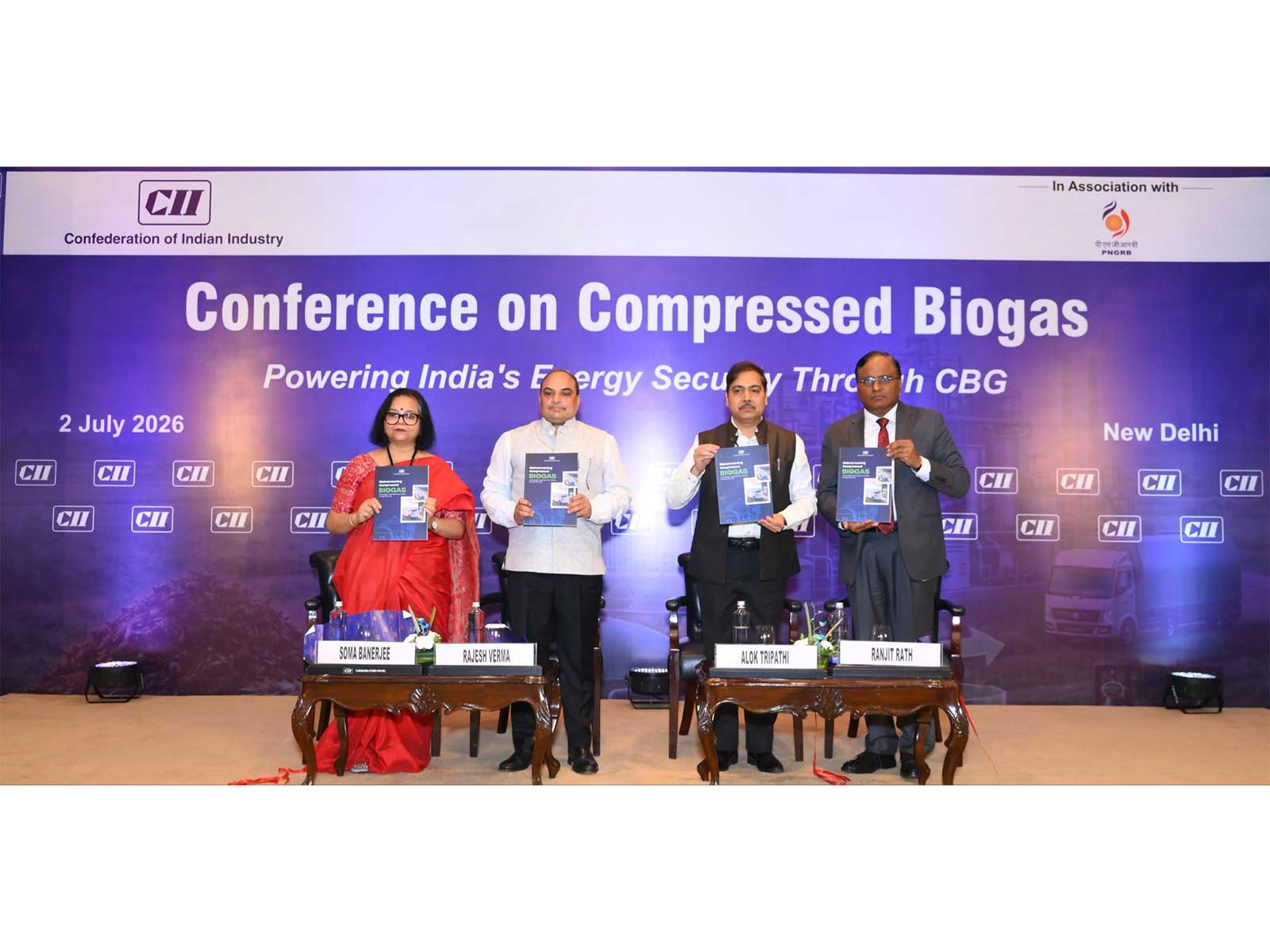
The study, titled ‘Mainstreaming Compressed Biogas (CBG)’, was released at a conference in New Delhi organised in association with the Petroleum & Natural Gas Regulatory Board. It presents a comprehensive strategic roadmap to position CBG as a mainstream pillar of national energy security, rural development, and decarbonization.
Against the backdrop of rising global energy demand and import dependence, the analysis evaluates sectoral growth under different trajectories up to 2030, concluding that long-term sustainability will depend upon diversified offtake across industrial, transport, and commercial sectors rather than relying solely on mandatory blending.
To accelerate this transition, the industry body recommended a comprehensive reform agenda. This includes rationalizing GST to 5 per cent across the entire CBG value chain and equipment, operationalizing Renewable Gas Certificates (RGCs), and permitting the private trading of Fermented Organic Manure (FOM).
The report also advocates for infrastructure expansion, including dedicated pipeline injection facilities, alongside the strengthening of biomass aggregation systems and the establishment of a National Bioenergy Mission.
Chandrajit Banerjee, Director General, CII, highlighted the domestic potential of the sector. “With significant dependence on imported fossil fuel, compressed biogas (CBG) presents a strategic opportunity to enhance energy security, promote circular economy practices, reduce emissions, improve waste management, and create additional income opportunities for farmers,” Banerjee said.
The report builds upon existing policy frameworks to outline a path toward long-term commercial viability and investment attractiveness.
Ranjit Rath, Chairman, CII National Hydrocarbon Committee and Chairman & Managing Director, Oil India Ltd., stated that the report articulates a strategic roadmap for mainstreaming compressed biogas by building upon the policy momentum created through SATAT and the CBG Blending Obligation.
“It advocates a calibrated transition from policy-induced demand to a diversified, market-driven renewable gas ecosystem capable of ensuring long-term commercial viability, investment attractiveness and energy security,” Rath said.
By integrating international practices with India’s biomass potential, the study envisions a self-sustaining ecosystem that reduces import dependence and supports long-term Net Zero ambitions. (ANI)
Related reading