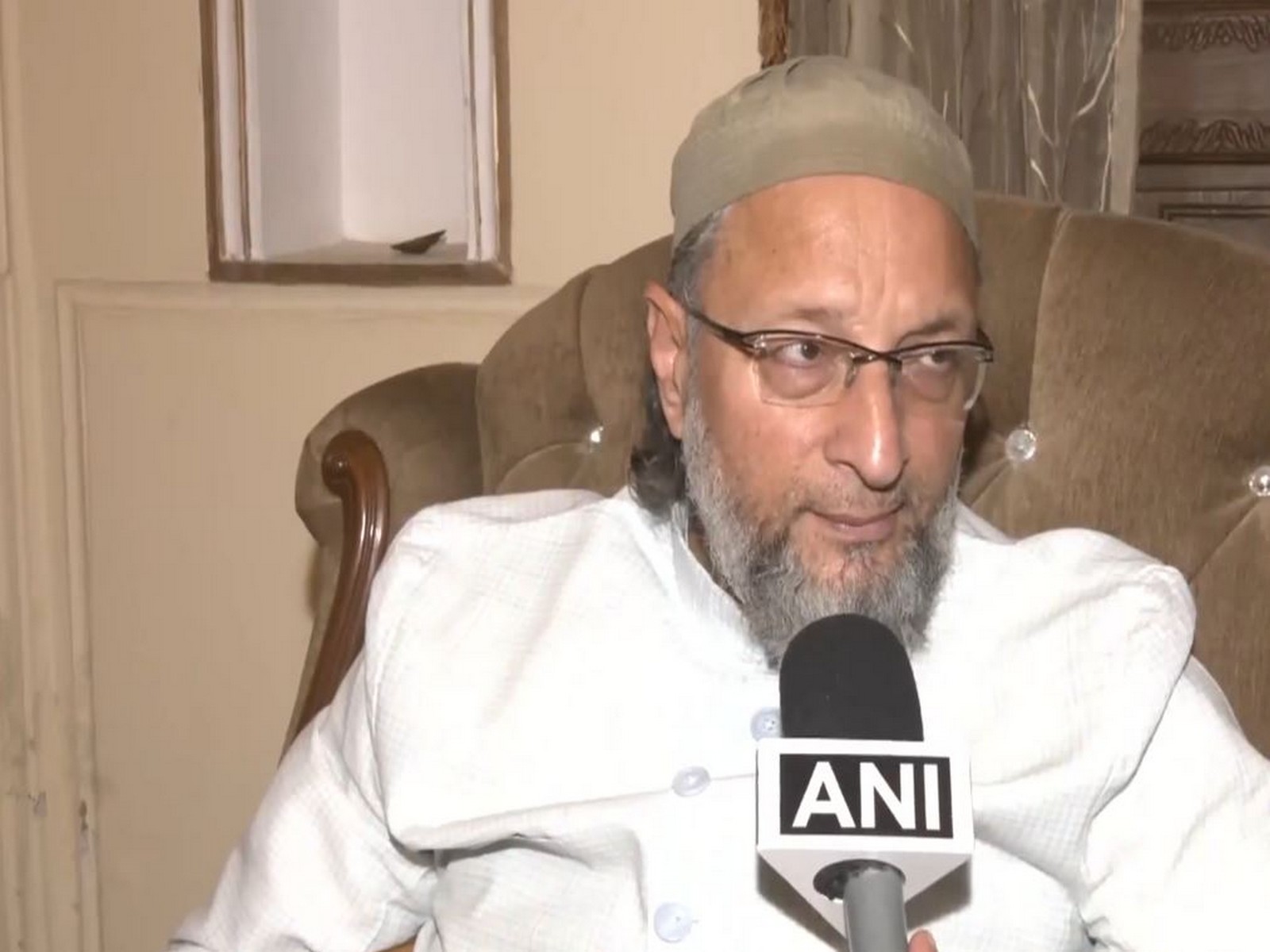
Hyderabad (Telangana) [India], June 25 (ANI): AIMIM chief Asaduddin Owaisi on Thursday criticised the government’s approach to citizenship verification, suggesting that current rhetoric aims to create an environment of systemic exclusion.
Speaking in Hyderabad, Owaisi expressed concern over the shifting criteria for proving Indian nationality, questioning the future implications for ordinary citizens.
The AIMIM leader expressed deep scepticism regarding the government’s long-term agenda. He alleged that the administration seeks the power to arbitrarily challenge the citizenship status of individuals.
In a pointed remark on the potential for political weaponisation, Owaisi added, “Maybe the government is saying that in 2030, only people who have a BJP membership card will be called an Indian citizen.”
Owaisi addressed the validity of a passport as an instrument of citizenship, citing the Passport Act of 1967. He noted that the document is only issued after rigorous police verification, affirming the bearer’s status as an Indian citizen.
“A passport is only given to an Indian citizen. If you read the Passport Act 1967, it clearly says that a passport is not given to a non-indian citizen and a passport is given only after a thorough police verification. Then, if you are saying that only a citizenship certificate is proof, then a citizenship certificate is only given to those people who got citizenship through registration or naturalisation,” he said.
The Hyderabad MP argued against the narrative that a citizenship certificate should be the sole proof of nationality, explaining that such certificates are typically reserved for those who acquire citizenship through registration or naturalisation, a process he argued is inapplicable to the vast majority of the population born in the country.
“I am by birth and by choice, an Indian citizen. My generations and my grandfather’s grandfather was born over here. I feel that the government wants to retain the control to randomly ask any person, are you an Indian?” Owaisi stated, underscoring his own lineage to challenge the necessity of additional documentation.
His remarks come after the government clarified that a passport has never been considered proof of citizenship, adding that no such decision was taken either recently or in the last 12 years. The clarification referenced Section 20 of the Passports Act, 1967, which provides for the issuance of passports to non-citizens.
Further, Owaisi criticised the Uttar Pradesh government, alleging that it is selectively targeting a particular Muslim community while ignoring issues such as bonded labour and poor living conditions.
He accused the state administration of focusing on matters like Muslim marriages, food habits, and demolitions instead of addressing broader governance concerns.
His remarks came amid a growing political row over the alleged embezzlement of donations meant for the Ram Mandir in Ayodhya.
“The problem with the UP government is that they are too focused only on one Muslim community. They are only focused on Muslim marriages and what food is cooked. They are not worried about how bonded labourers were kept in abysmal conditions. They were beaten and starved of food. The focus of the BJP government in UP is only on one particular Muslim community. How to demolish their homes on flimsy grounds by using bulldozers, and how to use encounters to hit them. That is why these issues have happened. People are seeing what kind of ‘aastha’ is there in the rule of law,” Owaisi said.
Owaisi termed the alleged encounter of 28-year-old Bharat Bhushan Tiwari as “wrong” and said it should have been handled through lawful arrest and due judicial process instead of police action.
He said such incidents weaken democracy and go against the rule of law. A 28-year-old student and local activist from Bihar’s Bhojpur district died in a controversial police encounter on June 17.
“It is a wrong thing to do… It is a false encounter; they could have easily arrested him and presented him, but a very unfortunate thing has happened… I hope that no future encounters will take place because every Chief Minister, every Prime Minister, every Member of Parliament, and Ministers, we know we have taken an oath on the Constitution of India and we should abide by and rule by the rule of law, not by rule by gun. Whether it is Uttar Pradesh or Maharashtra, you cannot use bulldozers to demolish houses without following the due process of law. You cannot arrest someone and do an encounter. These are things which are weakening our democracy. We have courts of law which are independent. Let the courts of law decide,” Owaisi said. (ANI)
Related reading