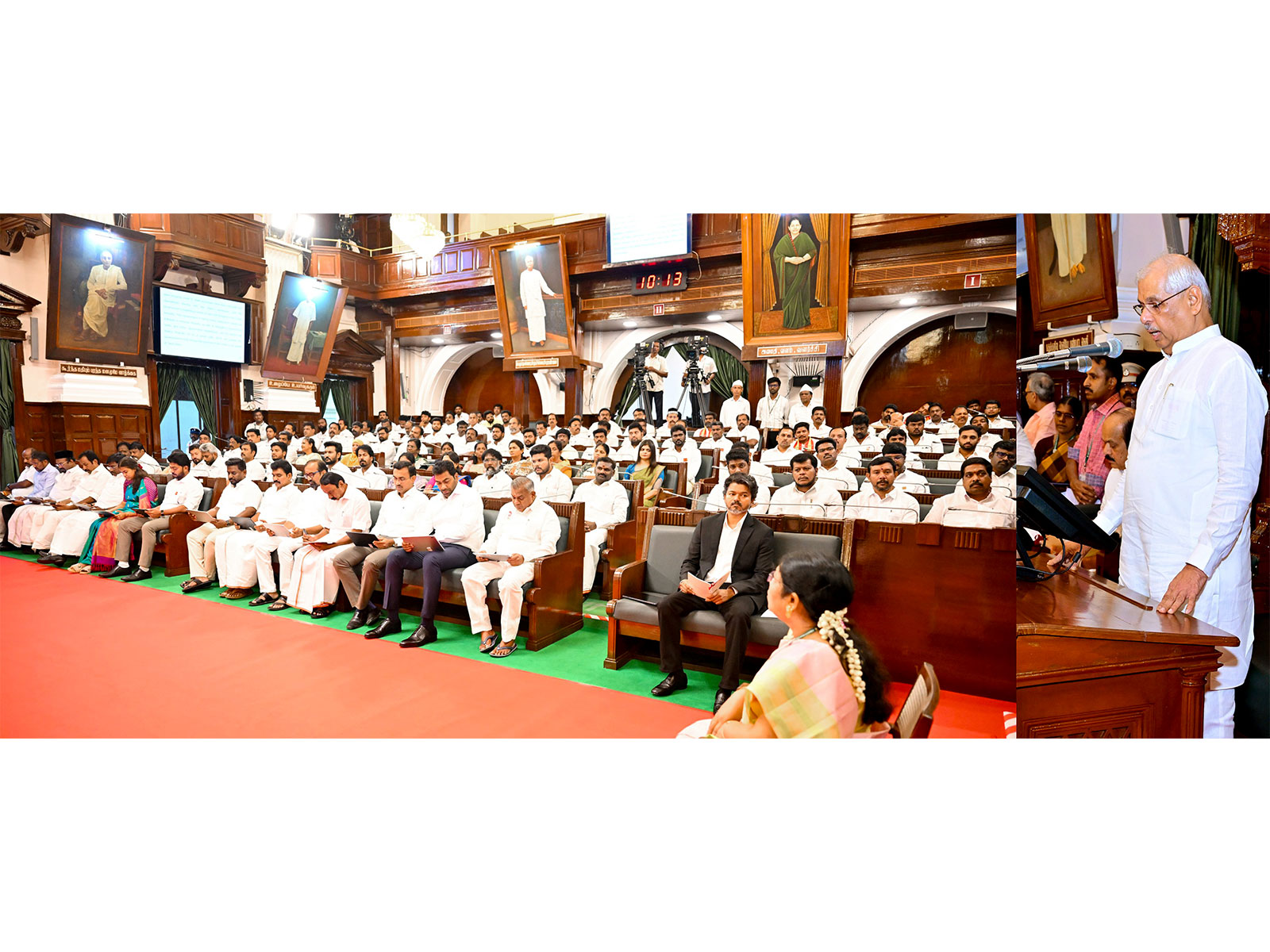
Chennai (Tamil Nadu) [India], June 18 (ANI): The first session of Tamil Nadu’s 17th Legislative Assembly began on Thursday with Governor Rajendra Vishwanath Arlekar delivered an extensive policy address that laid out the vision of Chief Minister C Joseph Vijay and the newly elected Tamilaga Vettri Kazhagam (TVK) government.
The address touched on a wide range of issues–from social justice and caste enumeration to interstate river disputes, education policy, law and order, financial reforms, and Tamil identity–while also triggering sharp political reactions from the Opposition DMK.
Opening the session after the rendition of Tamil Thai Vazhthu, Governor Arlekar described the 2026 Assembly election outcome as a historic political transformation.
“The Chief Minister in a short time achieved a feat of Himalayan scale by bringing about a new renaissance and a great widespread revolution in the political landscape of Tamil Nadu,” he said.
The Governor called the election result a “Whistle Revolution” and noted that TVK had formed a government within two years of its inception. He also highlighted the coalition government’s power-sharing arrangement as a first in the state’s 74-year political history.
Invoking the legacies of Periyar, BR Ambedkar, K Kamaraj, CN Annadurai, and MG Ramachandran, Arlekar said the government would be guided by principles of social justice, equality, and people’s welfare.
One of the most significant announcements in the Governor’s address was the government’s commitment to conduct a comprehensive “Social Justice Survey” after the Union government completes its caste enumeration exercise.
“It is a fundamental policy of this Government that true social justice lies in every community getting due representation,” Arlekar said.
The Governor stated that Tamil Nadu would first urge the Centre to complete caste enumeration alongside the national population census before carrying out its own statewide survey.
The government also reiterated its commitment to protecting Tamil Nadu’s 69 percent reservation policy and pledged continued support for minorities.
“I am confident that this Government will stand tall as a truly ‘Secular, Social-Justice’ Government,” Arlekar declared.
The Governor reaffirmed the state’s long-standing opposition to the National Education Policy (NEP) 2020 and the three-language formula.
Recalling the Assembly resolution passed under former Chief Minister Annadurai in 1968, Arlekar said, “From then until now, two-language policy has been adopted in Tamil Nadu. This Government will continue to follow this policy since the two-language policy is one that the people of Tamil Nadu have accepted.”
He criticised the Union government for allegedly withholding Rs 3,458 crore under the Samagra Shiksha Abhiyan and termed the linkage of education funds to NEP implementation “unacceptable.”
The Governor also announced that the state would continue demanding permission to use Tamil in proceedings before the Madras High Court and its Madurai Bench, while pressing for the establishment of a permanent Supreme Court Bench in Chennai.
Interstate water disputes featured prominently in the address, with the government taking a firm stand against Karnataka’s proposed Mekedatu dam project.
“The Government of Karnataka is attempting to implement the Mekedatu project. If this project is implemented, agricultural production as well as farmers’ livelihoods will be severely affected,” Arlekar said.
He announced that Tamil Nadu was taking “necessary legal measures” to halt the project and secure its rightful share of Cauvery water.
The Governor also vowed to oppose Kerala’s push for a new Mullaperiyar dam and reiterated Tamil Nadu’s demand to raise the water level of the existing dam.
“The Mullaperiyar dam is the lifeline of people of the southern districts,” he said.
The government, he added, would pursue repair works, strengthening measures, and efforts to raise the reservoir level in line with Supreme Court directions.
Additionally, the administration pledged to intensify efforts toward river-linking projects, lake restoration, groundwater recharge initiatives, and construction of check dams across the state.
At the heart of the Governor’s speech was the government’s long-term development blueprint titled Vetri Thamizhagam (Victory Tamil Nadu).
The vision document aims to transform Tamil Nadu into India’s model state by 2031 through ten pillars, including: Tamil identity and pride, dignified living and social security, welfare of women, welfare of youth, welfare of farmers, agricultural labourers and fishermen, world-class education, a prosperous Tamil Nadu, excellent healthcare and environment, world-class infrastructure and a people’s welfare Government and a good and transparent administration.
The government also promised a fully digitised administrative system, single-window industrial clearances, stronger action against crimes targeting women and children, and a statewide crackdown on drug abuse.
In one of the sharpest criticisms of the previous administration, Arlekar said drug culture had taken deep root in Tamil Nadu because of inadequate action in recent years.
“The primary cause of the breakdown of law and order in Tamil Nadu has been the widespread availability of drugs,” he said.
The Governor announced the formation of Special Drug Prevention Forces in every district and pledged to make Tamil Nadu drug-free.
He also revealed that the government had shut down 717 liquor outlets located within 500 meters of places of worship, educational institutions, and bus stands.
The administration plans to introduce stricter regulations to eliminate the illicit liquor trade and reform the excise sector.
Arlekar painted a concerning picture of the state’s finances, saying Tamil Nadu’s debt had reached nearly Rs 10 lakh crore.
“Every individual living in Tamil Nadu now bears a debt burden of more than one lakh rupees,” he said.
The Governor blamed fiscal mismanagement and corruption for revenue losses and announced reforms aimed at improving transparency.
Among them is an additional privilege fee on liquor manufacturers, expected to generate more than Rs 1,000 crore annually for the state treasury.
The government also pledged to eradicate corruption and digitise administrative processes to improve service delivery.
The Governor highlighted a memorandum submitted by Chief Minister Vijay to Prime Minister Narendra Modi covering several longstanding demands. These included: Opposition to the Mekedatu project; Concerns over the proposed Centre for Airborne Systems near Hosur; Welfare measures for Tamil Nadu fishermen; Increased highway and infrastructure funding; National institutions for Tamil Nadu; and Metro rail approvals for Hosur, Coimbatore, and Madurai.
Arlekar said the Chief Minister had reiterated these demands at the NITI Aayog Governing Council meeting and expressed hope that the Centre would respond positively.
The Assembly session was marked by protests from the Opposition DMK.
DMK legislators entered the House wearing black badges and staged demonstrations over what they alleged was a deterioration in law and order, particularly crimes against women and children.
Led by Opposition leader Udhayanidhi Stalin, members carried placards reading “Open your mouth, CM!” and “Can you hear the cries of anguish, CM?”
The party later staged a walkout from the Assembly, demanding that CM Vijay address the issue directly.
The session also unfolded against the backdrop of an ongoing controversy regarding the protocol order of Tamil Thai Vazhthu and the National Anthem.
Opposition parties, including DMK and AIADMK, had accused the new government of sidelining Tamil cultural traditions after changes in ceremonial arrangements during the swearing-in events.
However, Thursday’s session began with Tamil Thai Vazhthu, followed by the National Anthem, and concluded with the National Anthem once again.
MDMK General Secretary Vaiko welcomed the Governor’s address and praised the government’s development roadmap.
Vaiko said the Vetri Thamizhagam vision reflected a commitment to secularism, social justice, minority welfare, state rights, fishermen’s welfare, and transparent governance.
“The Governor has emphatically stated that the government will continue to uphold social justice, retain the two-language policy in Tamil Nadu, strongly advocate for state rights, and safeguard Tamil Nadu’s rights over river waters,” he said.
The veteran leader also welcomed the proposed Social Justice Survey, digitisation initiatives, anti-corruption measures, and the government’s promise to eradicate drug abuse and improve governance.
As Tamil Nadu’s new Assembly begins its first full session under the TVK government, the Governor’s address has offered an ambitious roadmap centered on social justice, Tamil identity, and administrative reforms. (ANI)
Related reading