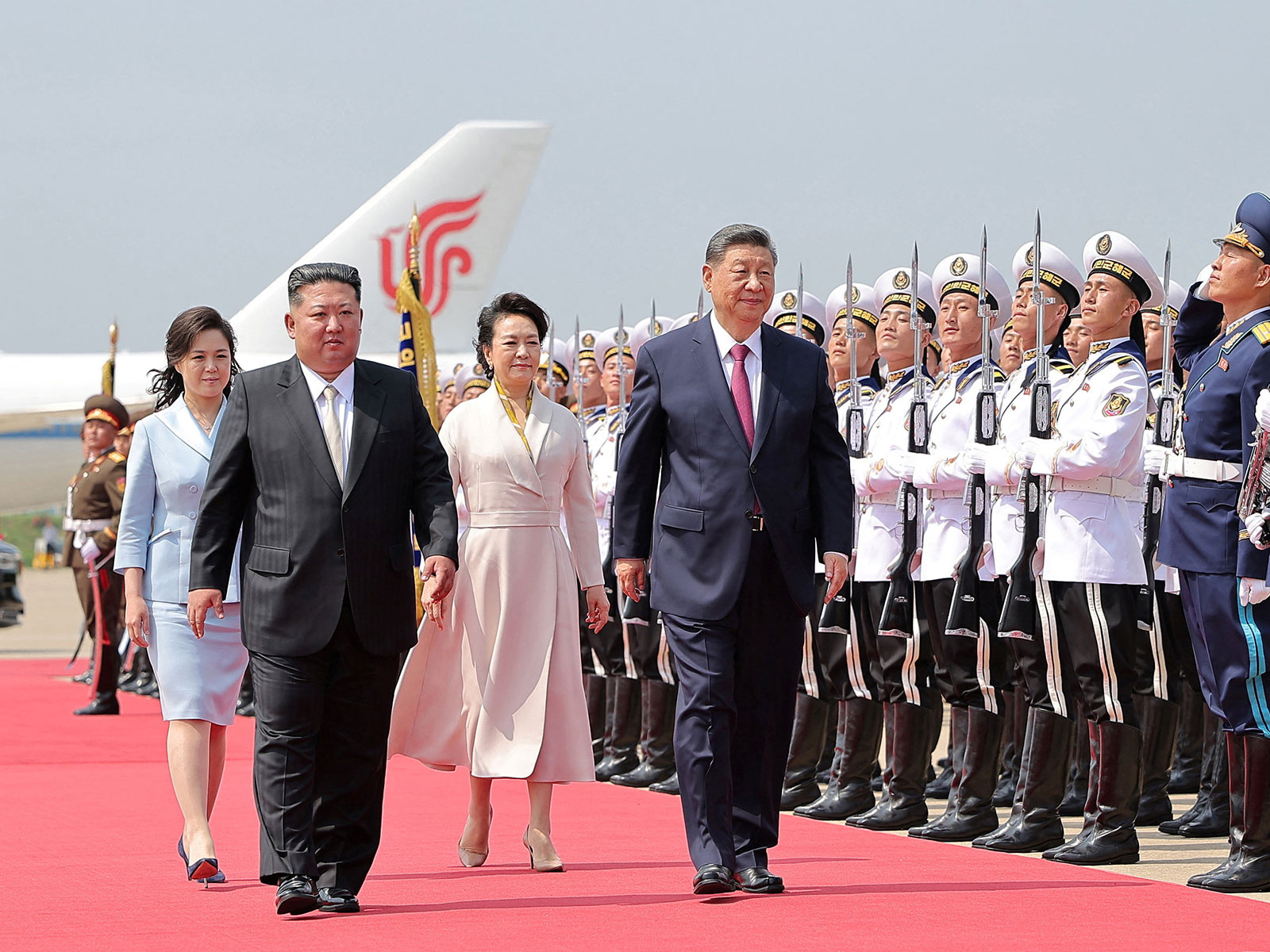
Hong Kong, June 16 (ANI): A flurry of diplomacy between China, Russia and North Korea continued when Chairman Xi Jinping paid his respects to Kim Jong-un in Pyongyang from 8-9 June. The strategic balance between these three powers is changing shape, and China is tacitly expressing its acceptance of North Korea as a nuclear state.
It is seven years since Xi visited the Hermit Kingdom – his first trip there – and Kim certainly rolled out the red carpet for his neighbour this time. According to state outlets, the relationship between China and North Korea is “as close as lips and teeth,” and China is one of the few allies that internationally ostracised North Korea counts upon.
Kim’s personal attendance at Xi’s military parade in September 2025 was the first time he had appeared alongside both Xi and Vladimir Putin, and also his first time at a multilateral event. The very next month, Kim hosted Chinese Premier Li Qiang and Russian Security Council Deputy Chairman Dmitry Medvedev to witness a nuclear missiles parade through Pyongyang. This by itself was ample evidence that denuclearisation on the Korean Peninsula is no longer a priority or prerequisite for China.
Yet Pyongyang has fallen more under the thrall of Russia in recent years. This is evinced by Kim dispatching thousands of troops to support Vladimir Putin’s bloody war of attrition against Ukraine. This gave strategic importance to Xi’s visit to Pyongyang, as he tries to maintain relations, if not sway, his unpredictable comrade from North Korea.
Indeed, Xi was attempting to remind Kim that China is his nearest and most important benefactor. As Xi expressed, China and North Korea are “linked by mountains and rivers and share a common destiny”. Xi explained that the two leaders had reached an important consensus to “grasp the trend of the times”.
Surprisingly, this was just the first overseas trip that Xi has taken this year, one that Kim described as of “utmost importance” amidst “upheaval in international affairs”. For Kim, it was important to have the leader of the world’s second-largest economy present on his turf. Accompanying Xi were his de facto chief of staff Cai Qi, Defence Minister Dong Jun, Foreign Minister Wang Yi and Commerce Minister Wang Wentao.
Pyongyang remains reliant upon China, especially as North Korea suffers from international sanctions because of its nuclear program. No hard deals emerged from this particular state visit, but it nonetheless provided good optics for both Xi and Kim. China has been a mainstay of political and economic support to North Korea since relations were forged in 1949. Their ties had been cemented by the Korean War, with Western sources estimating perhaps 400,000 Chinese soldiers died. It was therefore appropriate that Kim and Xi visited Friendship Tower, a commemorative site for Chinese soldiers.
There have been ups and downs, such as when Beijing normalised relations with Seoul, much to Pyongyang’s chagrin. When China recognised South Korea in 1992, this was a stunning move since China had fought against it 40 years earlier and had been an ardent supporter of the North. However, it demonstrated at the time that Beijing was pragmatic, willing to forego ideological purity for the sake of economic benefit. Of course, that was a different era to now.
Then, when North Korea detonated a nuclear device in October 2006, China responded by endorsing United Nations sanctions. This strained their relationship further, with North Korea’s repeated nuclear and missile tests since then usually attracting disapproval from China. The two countries had been gradually drifting apart until Kim’s visit to Beijing in March 2018 helped put things on a more even keel. Then, in an unprecedented flurry of exchanges, Kim met Xi again in May 2018, June 2018, January 2019 and June 2019. However, relations again took a hit after China closed its border during the COVID-19 pandemic, causing bilateral trade to tumble by 80% in 2020.
China was once seen as a major force in persuading North Korea to denuclearise. However, that level of influence was overblown. Furthermore, Beijing is not only accepting of Pyongyang’s nuclear capability, but it might even be seen as quietly supporting it.
Seong-Hyon Lee, a senior fellow at the George H.W Bush Foundation for US-China Relations in the USA, noted in an article for The Jamestown Foundation think-tank: “The Ninth Congress of the Workers’ Party of Korea in February heralded the start of a new geopolitical era in Northeast Asia. North Korea’s nuclear program is now codified in party doctrine, insulated from negotiation, and institutionally designed to outlast any diplomatic framework Washington might devise.”
He added, “The congress formally institutionalised Kim Jong-un’s drive to build nuclear and conventional forces in parallel, stipulating pre-emptive strike capabilities in party doctrine and announcing a sweeping five-year military modernisation agenda – shifting the nuclear deterrent’s declared mission from leverage to active war-fighting.”
Following this Ninth Congress, Xi proceeded to send a congratulatory message to Kim on 23 February, framing the event as an historical transition between past and future. On this, Lee remarked: “Tacit support from China has enabled Pyongyang’s shift. Over the past year, Beijing has recalibrated its policy toward North Korea, omitting reference to denuclearisation in joint statements and accepting proliferation as a new reality.”
Indeed, a January 2026 summit between China’s and South Korea’s leaders clarified this shift further when Xi refused to respond to the latter’s appeal for intervention. “By removing the precondition of denuclearisation from its diplomatic lexicon, Beijing has created the permissive strategic space for Pyongyang to execute the Ninth Congress’s hardline reforms. For China, this restores the optics of socialist solidarity without incurring the reputational cost of openly defending Pyongyang’s arsenal. For Kim, it provides a guarantee that has allowed him to rewrite North Korea’s constitution and strategic posture without fear of Chinese retaliation.”
Lee also noted: “The deepening trilateral relationship marks a restructuring of Eurasia’s political-security architecture. Moscow has clearly benefited through the combat deployment of over 10,000 Korean People’s Army troops to the front in Ukraine. In return, Pyongyang has extracted advanced military-technical assistance, combat experience for its officer corps, and potential transfers of aerospace and nuclear submarine technologies that could alter North Korea’s second-strike survivability.”
He added, “While divergent interests remain, sunk costs reinforce cooperation. Pyongyang has anchored itself to a veto-wielding patron that has openly declared North Korean denuclearisation a ‘closed issue’.”
Notably, China and North Korea have a defence pact that is now 65 years old. It is remarkable that this is the only country with which China holds such a treaty. Article II of that treaty compels Beijing to provide “mutual assistance” to North Korea in case of “armed attack”. Naturally, there has been debate over whether such a treaty is outdated now. After all, it was born at a time when the Soviet Union was regarded as the biggest threat. Certainly, Beijing does not wish to be drawn into an unnecessary war at North Korea’s behest.
However, neither country mentioned the issue of denuclearisation during Xi’s recent visit to Pyongyang. As mentioned earlier, China in recent years has kept silent about the topic, in contrast to former times when it did call for denuclearisation on the Korean Peninsula. Xi also wants North Korea to pursue his own personal vision of socialism. Thus, Xi said he hoped his visit would “jointly open up a brighter future for the socialist cause of both countries”. In China’s case, this involves tight one-party control but opening up to foreign markets and investment.
China certainly does not feel a desperate need to cultivate its sole remaining communist ally. It has become an economic and diplomatic force on the world stage, so Beijing does not really feel the need for support from a country pursuing an austere and old-fashioned form of communism. Beijing wishes to be in the top tier, not seen as a supporter of pariahs holding out on a system that does not work. It is obvious that North Korea does not give China credibility on the world stage or much of a financial advantage.
It could even be argued that impoverished North Korea is not a particularly good friend for China, and definitely, it has not shown the type of deference Beijing would like. Kim ascended the throne in 2011, but it was not till 2018 that he actually visited China. Instead, perhaps the greatest Chinese concern is a unified Korean Peninsula under Seoul’s influence, especially if it is aligned with the USA.
A buffer state is critical to Beijing so that it does not have a hostile or Western-aligned nation on its border. Yes, there is concern that North Korea has nuclear weapons – not that anything can be done about that now – but the greatest fear is regime collapse. China needs a counterweight to South Korea and the USA, and Kim’s regime supplies that in spades.
China would like the USA to reduce its military presence in South Korea, though President Donald Trump seems intent on achieving such a thing by reducing its global footprint without anyone’s prompting. Today, there are nearly 30,000 American troops stationed in South Korea, including 20,500 personnel from the US Army alone.
Certainly, one thing in Kim’s favour is his and Xi’s mutual animosity towards the USA. Both are engaged in an enduring ideological competition with the US. In the words of Kim, their bilateral relationship is “forged in blood” as “true comrades-in-arms that have shared life and death in the protracted struggle for opposing imperialism and building socialism, writing the proud history of friendship”.
Because China is competing with Russia for influence in North Korea, neither nation is putting much pressure on Kim. Lee therefore concluded in his assessment for The Jamestown Foundation: “Kim Jong-un has navigated the transition from a pariah state calibrating its nuclear program as a bargaining chip to a permanent nuclear power constitutionally anchored within a revisionist bloc deliberately structured to be self-sustaining, sanctions-resistant and immune to the diplomatic frameworks Washington has spent three decades constructing.” (ANI)
Related reading