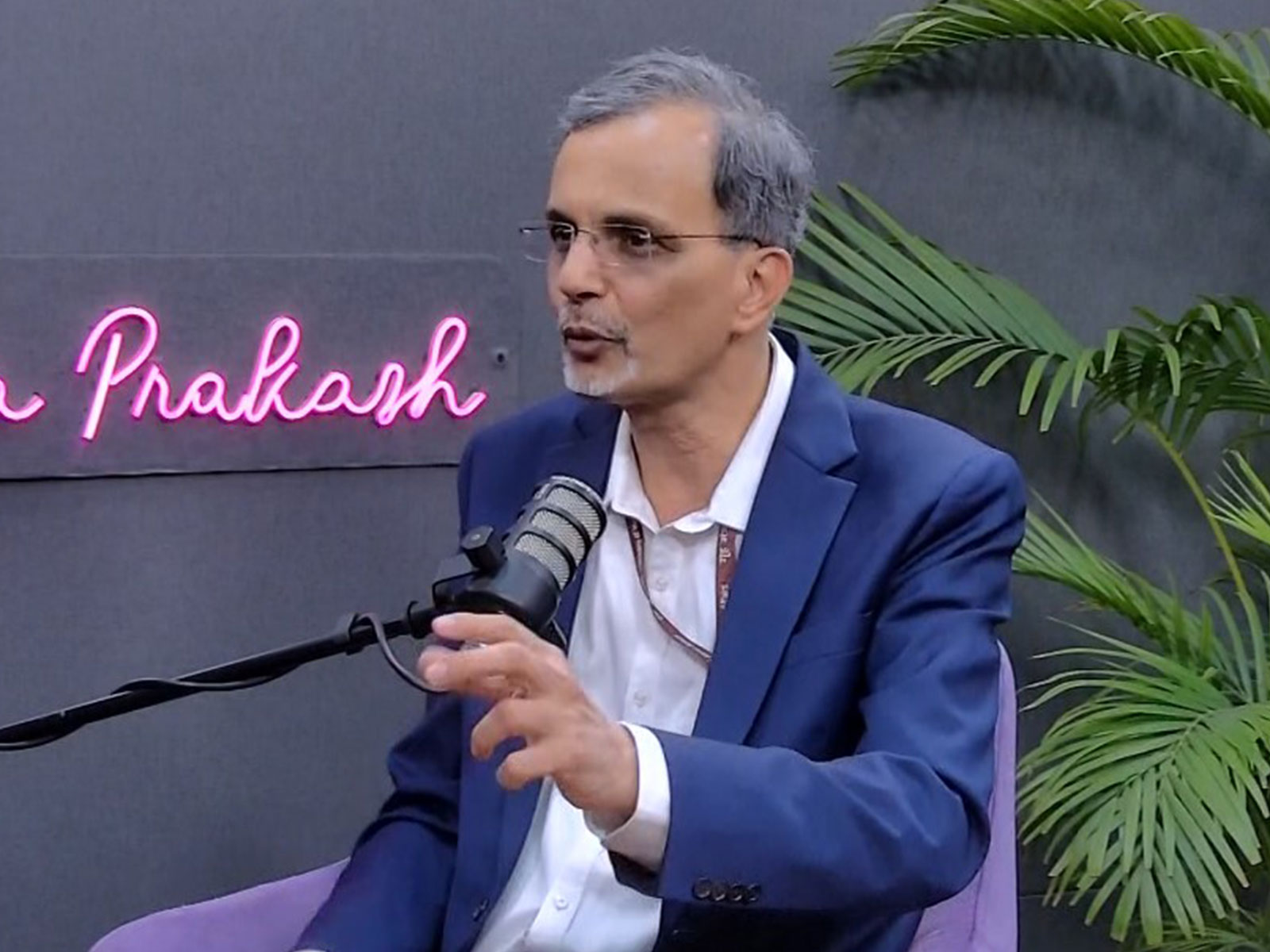
New Delhi [India], June 14 (ANI): India’s ability to adapt and innovate in changing circumstances would have been the biggest underestimation made by some economists regarding the health of the Indian economy, Chief Economic Advisor to the Government of India, V Anantha Nageswaran said on Sunday.
Answering queries about scepticism by some economists over the overall health of the economy and claims that there is too much of a focus on GDP growth numbers, the CEA said that such statements are made because they are “extrapolating in a linear manner and complex systems cannot be extrapolated linearly.”
“I think our resilience, our ability to adapt and innovate as circumstances change would have been their (economists) biggest underestimation because they’re extrapolating in a linear manner and complex systems cannot be extrapolated linearly. And an economy is a complex system and an economy housed within a democracy is, in a continent-sized economy…its complexity multiplies several times over,” CEA Nageswaran told ANI in an exclusive interview.
“You can’t make linear projections and say, in fact, some of the economies…. Dr (Raghuram) Rajan, when he was an RBI Governor, he very correctly said, ‘India is never as good as its optimists would like us to believe and never as bad as its pessimists would like us to believe’. He went into the basket of pessimists at some point of time,” Nageswaran added.
He said that such criticism of certain aspects of the economy stems from the numbers are not adding up to the expectations of certain economists regarding the country’s economic health.
“I think the problem with some of these critiques is that if the number doesn’t meet their prayers, expectations, then they are willing to call it, I don’t have trust in that number. And I wrote an article way back when India’s GDP methodology, as it stands, in the COVID year, in the first quarter, April to June 2021, Indian GDP went down by 25% year on year. At that time, nobody said this is a much exaggerated fall.”
Answering a query, he said India did not use its GDP methodology revisions to boost the growth number.
“GDP is an estimate. No country can pretend that they have an accurate way of measuring the GDP. In fact, I would say if there is one country in the world which has not used its GDP revisions as we have done to boost the number, it is India. Now, when MOSPI did this exercise, changing the base year from 2011-12 to 22-23 and changing the methodology,” he said.
“If they (MoSPI) had said Indian GDP was no longer 354 lakh crores but 384 lakh crores, people would have accepted that. That is what many countries do. In fact, we are the only country which brought it down from 357 lakh crores to 345 lakh crores. And we did the same thing back in the base year 2011-12 also,” the CEA added.
Asked whether the calculations lean towards being more conservative, he said no artificial pumping of numbers is happening.
“I’m saying we produce reliable statistics. We follow internationally accepted methods and we don’t use the GDP methodological revisions to bump up numbers artificially. So that is not the philosophy here. So our philosophy is to let the statistics speak for themselves. And that is what MoSPI…nobody has accused MOSPI of having a political bias to imparting a political bias to our GDP numbers,” he said.
The CEA said that certain criticisms are born out of trying to confirm one’s biases – that is, if the numbers confirm preconceived notions, then they are seen as reliable, otherwise the numbers are called unreliable.
“What I’m saying is, If I expect the Indian economy, I want it to be bad and the statistics confirms it, then I’m quiet. If the statistics do not confirm my belief or wish that the Indian economy is actually in a bad state, then the statistics are unreliable. So I find this inconsistency difficult to accept,” he said.
Speaking on India’s ability to adapt and innovate, CEA Nageswaran highlighted how, since 1999, India’s startup ecosystem and the service sector have exploded.
“In 1999, 2000, would anybody have made the prediction that India would become a major player in IT-enabled service…that is one example. Second example, 20 years ago, I don’t think anybody would have predicted that India’s startup and incubation ecosystem would have spread to not only tier one cities, but also tier two and tier three schools, universities and colleges,” he said.
Citing example of Indian Institute of Technology, Chennai, the CEA said that such support is seen across other colleges too.
“You feel as if you are in some kind of a developed country, a university ecosystem with that kind of startup ecosystem and the innovation that is going on. I’m sure it is mirrored in other IITs. I’ve seen it. I’ve seen some of them who come in. Once you go there, you can see the entire range of entrepreneurial adventures that are going on and experimentation.”
India’s Real GDP is estimated to grow by 7.7 per cent in FY 2025-26, while nominal GDP is expected to grow by 9.1 per cent, according to the Provisional Estimates (PE) of Annual Gross Domestic Product (GDP) for the 2025-26 financial year released by the Ministry of Statistics and Programme Implementation on June 6.
Real GDP or GDP at Constant Prices is estimated to attain a level of Rs 323.12 lakh crore in the FY 2025-26, against the First Revised Estimate (FRE) of GDP for the year 2024-25 of Rs 299.89 lakh crore. (ANI)
Related reading